
Do you like reading food memoir-type blogs? You know, the kind that feature charming and moving episodes from the blogger’s life, followed up with companion recipes and food porn-y photos. I do, but I think the poignant story/recipe/glossy photo format can be overused and stilted. Reading these blogs sometimes feels like eating rich meal after rich meal, and feeling unpleasantly full. Bloggers aren’t to blame for sort of writing, though; it seems to be a trend in food journalism these days.
I myself often fall into the personal story/recipe rut. As I was re-reading my original fish chowder post-- it went “this is a wonderful soup to eat on a cold day and it reminds me of this story from my childhood blah blah blah”-- I realized I was bored. So I re-wrote the post to make it more amusing for myself and my readers (all five of you.) Granted, my pictures are about as far from glossy food porn as you can get, but that doesn’t mean that I don’t want to be just like the cool kids. The first thing I tried to do when I laid my hands on my parents’ far nicer camera was to attempt to take arty close-ups set against a blurry background. Nobody bloggers like me imitate the big guns.
Still, there’s something to be said about blogs that just do recipes—no soul-searching, no memoirs, no food porn, just recipes, and lots of them. Anne's Food is a very charming example of such a blog; Simply Recipes is the best of the bunch. I’d also like to see more acidic, snappier food blog writing out there. Gastropoda is reliably curt and bitter but useful mostly to New Yorkers. I love The Hungry Tiger for its charming collection of vignettes that rarely exceed 200 words per post. (This blog is also my candidate for the next book deal.) The now-defunct Seasonal Cook demonstrates here and here how to write food memoirs that aren’t affected or dubiously upbeat. It’s all fine and good to eat rich, cheesy, starchy comfort food. But sometimes all you want is a spicy, citric starter.
Friday, January 25, 2008


Sunday, January 20, 2008
The poor and lazy man's fish chowder
 The road to the poor and lazy (wo)man’s fish chowder:
Three months before you make this soup: Stock up on frozen tilapia. Buy lots and lots of it, more than you’ll ever want to eat. Hey, it’s a) cheap, b) healthy, and c) a no-brainer to cook. (When you start making more money your tilapia consumption will fall drastically, as you’ll be able to afford more exciting seafood.) Nothing against tilapia, mind you. It’s a perfectly pleasant fish that you’ll be thoroughly sick of by the time you’re ready to make this soup. You can also substitute cod.
Two months: Start keeping an eye out for specials on shell-on shrimp. Eat most of the shrimp, but save and freeze the shrimp shells in a Ziploc bag. Try to save up about 3-4 cups of shrimp shells. Don’t forget to freeze some shrimp for the soup, you glutton.
Two weeks: You should really clean out your freezer. Did you know that you have tilapia that’s been in there for God knows how long? Maybe you could do something new and different with it. Think about that. Look up some recipes.
One week: Remember those shrimp shells that you froze, like, months ago? Don’t they look disgusting? Remember how you’ve been meaning to do something new and creative with them, like make shellfish stock? Why don’t you try that? Go look up half a dozen recipes for shellfish stock.
Two days: You’re planning to roast the shrimp shells before lovingly simmering them for hours with aromatics, like more ambitious bloggers? Ha. No, you’ll actually toss the shrimp shells in a crock pot. You can make shellfish stock in a crock pot, right? Googling “fish stock crock pot” proves inconclusive, but whatever. Cover the shrimp shells with water, and add a splash of white wine and some carrots, celery and onion, and simmer on low for eight hours. Cool, strain, and pour into containers and freeze. Wasn’t that easy? Don’t you feel like a good, virtuous little housewife? Oh, and don’t forget to air out your apartment.
Fish chowder day: Pick a bitterly cold day. Soup tastes better on a cold day. Get out your shrimp stock, shrimp and tilapia. Sauté some chopped onions, carrots, and green pepper in olive oil on medium-high heat in a heavy soup pot. Lower the heat and added minced garlic, some dried thyme, red pepper flakes and salt. Deglaze the soup pot with ½ cup white wine.
Add 4 cups shrimp stock; ¼ tsp. crushed saffron threads; 1.5 cups of good canned tomatoes, chopped; 1 tsp. sugar; and a couple of bay leaves. Bring to a boil, then lower the heat and let the whole thing simmer for 10 minutes.
Add a tilapia fillet (about 8 oz), cut into chunks. When the tilapia is done, in about 4 minutes, add about ½ cup of shrimp (about 4 oz). Simmer the soup for a couple of more minutes, and add 2 tbs. chopped basil, a splash of lemon juice, and a pinch each of salt and sugar. Top the soup with chopped parsley before serving. Eat with crusty bread or over rice. Want more starch? You could even make this with potatoes (add some peeled potatoes, cut into ¾-inch chunks, to the simmering shrimp stock. Cook until the potatoes are done before adding the tomatoes and other ingredients.)
Post-soup: Feel virtuous. Rub your belly. Glow. You’ve made a delicious soup out of boring frozen fish and gross-looking shrimp shells. You’re a resourceful and creative cook. You rule. Your fish chowder rules. Peace.
Tuesday, January 15, 2008
Soup blogging: Ugly yet delicious spicy chicken rice soup
 This is a delicious yet very ugly soup that I don’t recommend you make for company. For yourself, sure; for others, no. The original recipe, which, unlike mine, is quite photogenic, ran on a Finger in Every Pie back in November. That recipe calls for simmering lemongrass and ginger in turkey stock before adding the aromatics, shredded turkey, bok choy and herbs. When I got around to making this soup last week, I didn’t have all of the ingredients or remember the recipe instructions, but that never stops me. I wanted a gingery, spicy chicken rice soup, so this is what I came up using what I had in the kitchen.
For the stock, I used a roast chicken carcass, which I put in a crock pot with an onion, a couple of carrots, and some celery stalks, 2-3 bay leaves and a splash of white wine. All this was covered with cold water and simmered on low for about eight hours. I cooled the stock, refrigerated it and degreased it the next day. (This is the easiest, laziest way of making homemade chicken stock.)
For the soup, I brought the 6 –7 cups of stock to a simmer and tossed in a couple of 1-inch pieces of peeled ginger, 1/8 cup fresh lemon juice, and a couple of teaspoons of salt.
Meanwhile, I sautéed a large chopped onion, a couple of chopped carrots and celery stalks, and some minced garlic and ginger in olive oil. When the onion was golden and the vegetables were soft, I added them to the stock, along with ¼ cup of uncooked rice, and let the soup simmer for 9-10 minutes, until the rice was almost done. I then added a tablespoon of soy sauce, a tablespoon of hoisin, two tablespoons of chili garlic sauce (I used Blue Dragon brand, not very spicy. Adjust to taste.), and a splash of fish sauce.
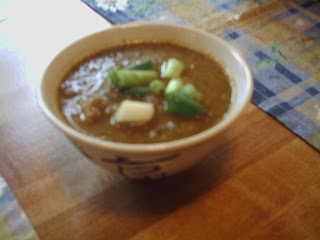
I took the soup off the heat and pureed about 1/3 of it in a blender, along with some chopped scallions and basil. (Actually, I tossed in some spinach into the soup pot before pureeing by mistake, which accounts for the soup’s hideous green color. Oops. Do not do this--add your greens after pureeing). The soup went back into the pot with shredded roast chicken meat, and another splash of soy sauce, fish sauce, garlic chili sauce and lemon juice. I topped the soup with chopped scallions, but it would also be good topped with sesame seeds, sesame oil or herbs like cilantro and basil.
Wednesday, January 09, 2008
2008 Food/Blog Resolutions
It’s a bit late for New Year’s resolutions, but what the hell. In 2008, I resolve to:
*Drink more coffee. I like coffee and cappuccino and lattes and all that crap, but I’m rarely willing to shell out $3+ for a shot of espresso and some hot milk. Food snob that I am, I’m also not willing to drink pre-ground, drip coffee. So this year I am acquiring a coffee grinder and a French press. Hey, the local coffee expert says my attempts will be at least as good as Starbucks'.
*Try more new recipes from my cooking bible, Please to the Table, especially soups, salads and appetizers. I’m a pretty lazy cook, actually. Sometimes all I want to make is roasted cauliflower or butternut squash, my equivalent of sticking a frozen pizza in the oven.
*Cook more with alcohol. French onion soup made with brandy. Chicken and pork in Calvados-spiked sauce. Coffee with steamed milk and Bailey’s. Fruit-infused vodka.
*Make more appetizers, period. Small plates are all the rage, haven't you heard?
*Pickle and marinate stuff. Attempt to make homemade sauerkraut, again. And pickled mushrooms.
*Give a dinner party, and, consequently, be praised for my cooking by people who are not related to me.
*Do all of the above and while sticking to my calorie restriction/optimal nutrition experiment five days a week. At least the optimal nutrition part.
*Have this blog noted just once in the local media. Come on, MKE and OnMilwaukee, it’s not like you have anything better to write about.
*Blog more. Ha.
*Drink more coffee. I like coffee and cappuccino and lattes and all that crap, but I’m rarely willing to shell out $3+ for a shot of espresso and some hot milk. Food snob that I am, I’m also not willing to drink pre-ground, drip coffee. So this year I am acquiring a coffee grinder and a French press. Hey, the local coffee expert says my attempts will be at least as good as Starbucks'.
*Try more new recipes from my cooking bible, Please to the Table, especially soups, salads and appetizers. I’m a pretty lazy cook, actually. Sometimes all I want to make is roasted cauliflower or butternut squash, my equivalent of sticking a frozen pizza in the oven.
*Cook more with alcohol. French onion soup made with brandy. Chicken and pork in Calvados-spiked sauce. Coffee with steamed milk and Bailey’s. Fruit-infused vodka.
*Make more appetizers, period. Small plates are all the rage, haven't you heard?
*Pickle and marinate stuff. Attempt to make homemade sauerkraut, again. And pickled mushrooms.
*Give a dinner party, and, consequently, be praised for my cooking by people who are not related to me.
*Do all of the above and while sticking to my calorie restriction/optimal nutrition experiment five days a week. At least the optimal nutrition part.
*Have this blog noted just once in the local media. Come on, MKE and OnMilwaukee, it’s not like you have anything better to write about.
*Blog more. Ha.
Wednesday, January 02, 2008
Soviet Kitsch: Sandwiches and Canapes
Looking for appetizer ideas? Why not consider this Soviet cookbook from the 1960s? Seriously.
 Admittedly, when it comes to food, I’m no fan of all things retro. I don’t collect old cookbooks, I have no interest in making “gourmet” versions of 60s stalwarts like tuna casserole, and I’ve never perused the Gallery of Regrettable Food. That said, I do have a soft spot for my mom’s collection of Soviet cookbooks and recipe cards. This is partly because they’re a slice of a historical era that holds some interest for me, and also because they often have useful hints and techniques for under-quipped cooks, like making dumpling dough sans pasta machine.
I rarely turn to these cookbooks for actual recipes, which tend to be minimalist (grated carrots), unappetizing (boiled sausage and potatoes), or both. Plus, these books never list exact ingredient amounts, oven temperatures, or introduce recipes. Soviet cookbooks are entirely food-porn free, as eating and cooking was a pragmatic affair for their readers. A rare exception is this little booklet on sandwiches and canapés. Yes, the photography is terrible (yet no worse than mine on this blog), but the sandwich and appetizer ideas are charming, original and totally edible.

 Sandwich towers made with toasted rye bread rounds and stacked with cucumber, cheese, tomato, hardboiled eggs, ham, smoked fish and what have you.
 Sandwich sailboats--toasted white bread and Swiss cheese sails, held in place with a toothpick. When I was a kid, this is all I would eat at times.
 Some sort of smoked fish--herring or mackerel--with hard-boiled eggs and red pepper. Note the scenically positioned whole fish, complete with heads, tails, and eyes. Yum.

I rarely turn to these cookbooks for actual recipes, which tend to be minimalist (grated carrots), unappetizing (boiled sausage and potatoes), or both. Plus, these books never list exact ingredient amounts, oven temperatures, or introduce recipes. Soviet cookbooks are entirely food-porn free, as eating and cooking was a pragmatic affair for their readers. A rare exception is this little booklet on sandwiches and canapés. Yes, the photography is terrible (yet no worse than mine on this blog), but the sandwich and appetizer ideas are charming, original and totally edible.

 Sandwich towers made with toasted rye bread rounds and stacked with cucumber, cheese, tomato, hardboiled eggs, ham, smoked fish and what have you.
 Sandwich sailboats--toasted white bread and Swiss cheese sails, held in place with a toothpick. When I was a kid, this is all I would eat at times.
 Some sort of smoked fish--herring or mackerel--with hard-boiled eggs and red pepper. Note the scenically positioned whole fish, complete with heads, tails, and eyes. Yum.
 Friday, December 28, 2007
Herring in a Fur Coat
 Around this time of the year, Christmas well-wishes are usually followed up with “Uh, do you celebrate Christmas?” I guess I do, although this is not at all common in Russian-Jewish immigrant families. New Year's--a Soviet-ized Christmas, really--is the big holiday for Russians, but Christmas itself is generally ignored. As for Hanukkah, few Russian Jews celebrate it in earnest. This holiday is usually commemorated by saying “Hey, it’s Hanukkah!” on the second of the eight days and then forgetting about the whole thing.
My parents and I, though, are accidental non-conformists: ever since we came to the U.S., we happened to receive annual Christmas dinner invitations by our respective American friends. Add to that my childhood yearnings for an American Christmas, and you get holiday revelry chez Yulinka: a tree that stays up mid-December through early January; a festive dinner and gifts on Dec. 25, and a classic Russian appetizer and vodka spread on Dec. 31. And so it was this year.
St. Nick looked over a very American dinner of stuffed pork loin and roasted butternut squash...
 ... while an Old World babushka made sure that homemade sauerkraut, picked tomatoes and herring in a fur coat made an appearance on the table.
  Herring in a coat (seledka pod shuboi), the Russian version of seven-layer salad, is usually made for New Year’s, but it’s often served at festive dinners year-round. A layer of herring is covered with beets, potatoes and eggs, dressed with mayo, and topped with herbs, onions and sometimes olives. Every family has its own recipe, but I think my mom’s has a leg up thanks to a layer of tart apple that gives this rich appetizer a nice kick.
Method: Herring in a fur coat is best when made 12-24 hours before serving and left to “marinate” in the fridge.
You will need:
-1 smoked/salted herring fillet (about 1 lb, sold prepackaged at Russian stores; not pickled herring)
-2 small cooked, cooled and peeled potatoes and 1 large, cooked beet. Bring water to a boil in a sauce pan, add the beet and the potatoes, turn the heat to a simmer and cook until you can easily poke the vegetables through with a knife. The potatoes will take about 30 minutes; the beets, 1-1.5 hours.
-2 large, hardboiled eggs
-1 small, peeled Granny Smith apple (or another tart variety)
-1/2 small red onion, minced, plus a few thinly sliced pieces
-2 tbs. each chopped scallions, parsley and/or dill
Dressing:
In a small bowl, combine 1/4 cup mayo, 1/4 cup sour cream (or thick Greek yogurt), a dash of salt and pepper, and a splash of vinegar.
Cut the herring into small pieces (about 1/8-inch) and spread evenly on a big, round plate or serving dish. Dice the potatoes and spread over the herring. Sprinkle with some finely chopped red onion.
Spread about 3-4 tablespoons of dressing over the potatoes and herring. Grate the apple over the potato layer, and spread 3-4 tablespoons of dressing on top. Sprinkle with finely chopped red onion.
Grate the beet and the eggs over the apple layer. Top with the remaining dressing (make more as needed) and chopped scallions, parsley, dill, and thinly sliced onions. To serve, use a butter knife to slice and transfer to individual plates with a spatula.
You will need:
-1 smoked/salted herring fillet (about 1 lb, sold prepackaged at Russian stores; not pickled herring)
-2 small cooked, cooled and peeled potatoes and 1 large, cooked beet. Bring water to a boil in a sauce pan, add the beet and the potatoes, turn the heat to a simmer and cook until you can easily poke the vegetables through with a knife. The potatoes will take about 30 minutes; the beets, 1-1.5 hours.
-2 large, hardboiled eggs
-1 small, peeled Granny Smith apple (or another tart variety)
-1/2 small red onion, minced, plus a few thinly sliced pieces
-2 tbs. each chopped scallions, parsley and/or dill
Dressing:
In a small bowl, combine 1/4 cup mayo, 1/4 cup sour cream (or thick Greek yogurt), a dash of salt and pepper, and a splash of vinegar.
Cut the herring into small pieces (about 1/8-inch) and spread evenly on a big, round plate or serving dish. Dice the potatoes and spread over the herring. Sprinkle with some finely chopped red onion.
Spread about 3-4 tablespoons of dressing over the potatoes and herring. Grate the apple over the potato layer, and spread 3-4 tablespoons of dressing on top. Sprinkle with finely chopped red onion.
Grate the beet and the eggs over the apple layer. Top with the remaining dressing (make more as needed) and chopped scallions, parsley, dill, and thinly sliced onions. To serve, use a butter knife to slice and transfer to individual plates with a spatula.

Saturday, December 22, 2007
Food blogs that should exist, but don’t
Looking for a unique food blog theme? With more than 40,000 food blogs out there, a theme or a niche is a good idea. Plenty of bloggers take nice pictures and post good recipes, but there’s nothing that really distinguishes them from thousands of other foodies. Most big bloggers have some sort of a theme: Amateur Gourmet, self-explanatory; Chocolate and Zucchini, cooking and eating in Paris ; Gluten-Free Girl, learning to live and cook sans wheat. Even this little blog was more successful when I followed my Russian cooking theme. Believe it or not, people come here for the tvorog and eggplant caviar recipes, not for my sallies on kitchen economics.
I'm offering the following food blog ideas for budding bloggers. Don't thank me; the pleasure is all mine. (I wouldn't be surprised if these blogs were already around, though. Let me know if they are.)
Dinner and a movie: A foodie film buff reviews movies and writes about food.
Testing the American Test Kitchen’s recipes: Just like the Wednesday Chef tests recipes published in the New York Times and the LA Times, I’d like to see a blog that reviews recipes from America's Test Kitchen's Cook's Illustrated. (This is the magazine devoted to developing the “best” recipe for everything.) Nearly every recipe they come up with has some sort of gimmick or trick to it—do these really work?
Poor foodie: There used to be a good blog, Frugal Foodie, about cooking on the cheap. Unfortunately, it hasn’t been updated since last February. Won’t someone take over?
CRON foodie: Cooking good food on the calorie restriction/optimal nutrition diet (cron). Most cronies eat pretty miserable food: raw kale salads, fat-free cheese. It doesn’t have to be this way—Kalyn and Fat-Free Vegan make tasty-looking, healthy food. I’d like to see this type of blog with a cron bent.
Soup blog: All soup, all the time. This blog has to be out there. Please point me to it.
I'm offering the following food blog ideas for budding bloggers. Don't thank me; the pleasure is all mine. (I wouldn't be surprised if these blogs were already around, though. Let me know if they are.)
Dinner and a movie: A foodie film buff reviews movies and writes about food.
Testing the American Test Kitchen’s recipes: Just like the Wednesday Chef tests recipes published in the New York Times and the LA Times, I’d like to see a blog that reviews recipes from America's Test Kitchen's Cook's Illustrated. (This is the magazine devoted to developing the “best” recipe for everything.) Nearly every recipe they come up with has some sort of gimmick or trick to it—do these really work?
Poor foodie: There used to be a good blog, Frugal Foodie, about cooking on the cheap. Unfortunately, it hasn’t been updated since last February. Won’t someone take over?
CRON foodie: Cooking good food on the calorie restriction/optimal nutrition diet (cron). Most cronies eat pretty miserable food: raw kale salads, fat-free cheese. It doesn’t have to be this way—Kalyn and Fat-Free Vegan make tasty-looking, healthy food. I’d like to see this type of blog with a cron bent.
Soup blog: All soup, all the time. This blog has to be out there. Please point me to it.
Monday, December 17, 2007
On (Not) Wasting Food
Have you heard of the Wasted Food blog? Jonathan Bloom chronicles food waste in America while writing a book on this topic. Bloom’s blog strikes a chord with me. To paraphrase a comment I left elsewhere:
I lived in Soviet Russia until I was 9. My grandmother, who survived the Leningrad blockade (when a lot of people starved to death), was a fanatic about not wasting food. I grew up hearing about how she “saved” food that was on the verge of spoiling, or that we had too much of thanks to Soviet surpluses. Milk got turned into homemade cottage cheese; limp cabbage became sauerkraut.
While I never went hungry as a child, certain foods, like bananas, were very rare treats when I was growing up. I loved bananas, but they would only be sold once or twice a year and you had to wait in line for hours to buy them. I wouldn’t have dreamed of tossing a banana.
When I came to the U.S. I was shocked by how much food kids at school threw away. They tossed out bananas! Even back then I would always save whatever I hadn't eaten for lunch and take it back home. I carried my little brown lunch bag all through recess. I still hardly ever throw food away. There's something callous about wasting food.
Bloom and his commenters are often perplexed about how not to waste food, but actually it’s pretty easy. Stick to a grocery budget, make soup stock out of those wilted vegetables and leftover chicken parts, plan ahead. In fact, like, home cooking on a budget, what it really takes is planning and an innate interest in cooking. When I buy groceries I always think about what I can do with leftovers, so planning has become second nature.
In contrast, I recently cooked dinner with a friend who gave me carte blanche to make whatever I wanted. It was past 7 p.m. on a weekday I had decided on roasted salmon and potatoes. We made a beeline for the grocery store to pick up the ingredients. (Have I mentioned that this friend has a minimally stocked pantry and little cookware?) Shopping without looking at what’s on sale, without a plan for using leftovers—-what strange, unsettling feeling!
Commenters on Bloom’s blog are always looking for recipes incorporating leftovers. Nothing new from me this week, but here are some past offerings which make good use of whatever you may have in the fridge:
Milk: Make homemade cottage cheese (aka farmer's cheese, curd cheese or tvorog).
Cottage cheese: Bake muffins.
Cooked, cold chicken: Make chicken-stuffed crepes or chicken and spinach hachepouri.
Raw chicken, random vegetables: Make stock.
Tomatoes past their prime: Roast 'em.
I lived in Soviet Russia until I was 9. My grandmother, who survived the Leningrad blockade (when a lot of people starved to death), was a fanatic about not wasting food. I grew up hearing about how she “saved” food that was on the verge of spoiling, or that we had too much of thanks to Soviet surpluses. Milk got turned into homemade cottage cheese; limp cabbage became sauerkraut.
While I never went hungry as a child, certain foods, like bananas, were very rare treats when I was growing up. I loved bananas, but they would only be sold once or twice a year and you had to wait in line for hours to buy them. I wouldn’t have dreamed of tossing a banana.
When I came to the U.S. I was shocked by how much food kids at school threw away. They tossed out bananas! Even back then I would always save whatever I hadn't eaten for lunch and take it back home. I carried my little brown lunch bag all through recess. I still hardly ever throw food away. There's something callous about wasting food.
Bloom and his commenters are often perplexed about how not to waste food, but actually it’s pretty easy. Stick to a grocery budget, make soup stock out of those wilted vegetables and leftover chicken parts, plan ahead. In fact, like, home cooking on a budget, what it really takes is planning and an innate interest in cooking. When I buy groceries I always think about what I can do with leftovers, so planning has become second nature.
In contrast, I recently cooked dinner with a friend who gave me carte blanche to make whatever I wanted. It was past 7 p.m. on a weekday I had decided on roasted salmon and potatoes. We made a beeline for the grocery store to pick up the ingredients. (Have I mentioned that this friend has a minimally stocked pantry and little cookware?) Shopping without looking at what’s on sale, without a plan for using leftovers—-what strange, unsettling feeling!
Commenters on Bloom’s blog are always looking for recipes incorporating leftovers. Nothing new from me this week, but here are some past offerings which make good use of whatever you may have in the fridge:
Milk: Make homemade cottage cheese (aka farmer's cheese, curd cheese or tvorog).
Cottage cheese: Bake muffins.
Cooked, cold chicken: Make chicken-stuffed crepes or chicken and spinach hachepouri.
Raw chicken, random vegetables: Make stock.
Tomatoes past their prime: Roast 'em.
Roasted tomatoes, canned tomatoes, or tomato paste: Make chana masala soup.
Thursday, December 13, 2007
Russian Grocery Tour: Little Europe
 Do you have a hankering for sauerkraut and pirozhki? Do you miss standing in line for herring and smoked fish? Do you want to be verbally abused by a platinum-blonde cashier named Olga? Oh, yes, you do.
Welcome, nostalgic émigrés and curious Amerikantsi, to the Russian grocery store. Despite the evocative names these stores bestow on themselves—-Little Europe, Spartak—-they look oddly similar inside, as if some sort of Central Soviet Grocery Bureau mandated the décor. Invariably the size of a small living room, these stores are home to beige shelves, an ancient-looking cash register and fluorescent lighting. Promo posters of tarted-up pop stars are plastered on the walls, along with ads selling/seeking cars, jobs, nannies, wives, etc.
Yet if you push your way through the babushkas jostling around the fish counter, you will be rewarded with foodie gems and curiosities like marinated mushrooms, exotic dairy products and candy bars named after grizzly bears.
Join me, reader, as I take you on a multi-blog post tour of Milwaukee-area Russian groceries. We will negotiate back room caviar deals with gruff proprietors. We will investigate just what is in those frozen dumplings. We will buy herring. Ok, maybe we’ll just buy herring. In this first installment, we head over to Shorewood’s Little Europe.
UPDATE, March 2009: Little Europe has closed.
Location: 4517 N. Oakland Ave, Shorewood, Wis. (414) 967-8841
Atmosphere: See intro. A bit more spacious and better lighted than the average Russian grocery, though, complete with a little alcove for books, CDs and DVDs.
Customer Service: Surprisingly friendly and warm when one of the owners is working. Apathetic when a teenager (the owners’ son?) is putting in a shift.
Product selection: In addition to all the usual Russian goodies—-sunflower oil, tea, jars of marinated vegetables, kefir and cheeses—-Little Europe has some unusual offerings like frozen wild mushrooms. Also, there’s a very big selection of frozen pelmeni and other doughy goodies. For the poor folk, check out reasonably priced frozen fish. Nice selection of kitschy chocolate candy in the back; I recommend the tiny fruit candies in flavors like black currant and apricot.
A small selection of Russian books, magazines and CDs/DVDs for you Slavic studies majors.
Pricing: Good. Very reasonably priced loose-leaf tea. The frozen wild mushrooms range from $5.99 to $8.99 a bag. The dairy and the yummy marinated vegetables are pricier, but no sticker shock.
Buy: Frozen mushrooms.
Avoid: The uninspired rye bread, trucked in from Chicago. Can’t blame Little Europe, though. I think every Russian grocery in town sells this stuff.
Final rating: *** to ****, depending on who’s behind the counter
Rating key:
*Soviet cafeteria food
**Day-old buckwheat kasha
***Borsch made by a non-native
**** Babushka’s homemade pirozhki
*****Black caviar on a buttered baguette and a shot of chilled vodka
Thursday, December 06, 2007
Table for One
 Eating alone: I like it. Oh, I know I’m not supposed to. It’s anti-social and weird and is probably tied to overeating. From a foodie perspective, it’s not a great deal either: it’s makes no sense to cook large roasts or pans of brownies or pancakes for one. (There’s no such thing as a pancake recipe that serves just one.) And, c’mon, what kind of person really enjoys eating alone? That’s what you do when you’re stuck somewhere on a business trip, or when killing time at the airport, or when you’re a young single person living alone in your little apartment. Ahem.
But consider: When eating alone, you can eat and make whatever you like, with no concerns about how a potential dining partner will enjoy your efforts. For me that usually means roasted vegetables, and more vegetables: brussels sprouts with feta, cauliflower topped with a poached egg, butternut squash, eaten with a side of sautéed mushrooms and spinach. This is stuff you can’t serve to company. Guys, in my experience, particularly don’t take to it.
Eating alone also spares you from awkward social dynamics of eating with others. I once met a man, a real gourmet, who said that the best dining companions are a good headwaiter and a damn good sommelier. To this I would add that a magazine or a book is often as good of a dining companion as any. Eating one with a significant other, for instance, is never as blissful as it sounds: in the beginning, there’s a scramble for conversation topics and awkward pauses; a little later, long pauses and more interest in satiating hunger than in one’s partner; much later…talk about the miscellanea of life, I guess. Home repairs, yard work, kids. I wouldn’t know.
I admit that eating alone has its downsides: I like wine but I wouldn’t think of drinking alone; I miss feedback (that is, praise) for my cooking; I’d hesitate to eat alone at a restaurant with wait staff, though I admire people, especially women, who do so. An underappreciated dining companion, I think, is a reticent reader with an appreciation of food. When I was a kid one of my favorite things to do was to crunch on an apple while reading a favorite book. To this day my eyes often stray to whatever readable matter is on the table—newspapers, old mail, labels on condiment bottles. A good meal and a good book (or magazine, or newspaper, or even work, why not) in front of each diner, and voila: domestic bliss.
Oh, and here’s a loose recipe for my favorite roasted cauliflower with a poached egg. Serves 1, maybe 1.5.
Start with a small head of cauliflower. Cut the cauliflower into florets or just slice it diagonally. Put in a foil-lined pan and add a dash of kosher salt, ground black pepper, red pepper flakes, paprika, and olive oil. Roast for about 25-30 minutes, turning the cauliflower over halfway through the cooking time.
Five minutes before the cauliflower is done, bring a couple of cups of water and a splash of vinegar to a boil in a small saucepan. When the water is boiling, break a large egg or two into a saucer, making sure to keep the yolk whole. Turn down the heat to a very gentle simmer and carefully slip the egg into the water. Start a timer—you want to poach the egg for about 3.5 minutes. In the meantime, remove the cauliflower from the oven and and plate it. Grate or sprinkle some cheese over it—Pamesan, feta, whatever you like. Toast some nice bread. Your egg should be done by now. Use a slotted spoon to carefully remove it, gently shake off the excess water, and place the egg on top the caramelized cauliflower. Salt to taste. Jab the egg with a fork until the soft, gooey, eggy yolk seeps over the cauliflower. Eat. Use the bread to wipe your plate clean.
Saturday, December 01, 2007
Sugared Lemons

I’ve been drinking tea without sugar since I was a kid, but lately I’ve developed a sweet tooth. It’s not that I dump white sugar into my mug by the teaspoonful, but a little subtle sweetness isn’t unwelcome. I usually go for honey, fruit preserves or sugared lemons.
Sugared lemons are just what they sound like: blanched lemons, sliced thinly, and layered with sugar in a clean jar. The sugar works its magic, and a few days later you get lemon slices mingling with lemon syrup. Add a slice of lemon and a splash of syrup to black tea, and you’ve got nice lemon flavor minus harsh acidity.
Method:
Boil some water. Place your lemons in a bowl and splash some boiling water over them. This makes the lemons more fragrant.
While you’re at it, get a clean, empty jar big enough to hold your sliced lemons (jam jars work great), and swivel some hot water around in it. Pour out.
Cut the lemons into thin slices. Place in the jar and pour some sugar over the slices. How much sugar? Your call. I was taught to cover the lemons in sugar completely, but you can use less, of course. Refrigerate. The lemons will develop a nice sugar syrup in a day or two.
Sugared lemons are just what they sound like: blanched lemons, sliced thinly, and layered with sugar in a clean jar. The sugar works its magic, and a few days later you get lemon slices mingling with lemon syrup. Add a slice of lemon and a splash of syrup to black tea, and you’ve got nice lemon flavor minus harsh acidity.
Method:
Boil some water. Place your lemons in a bowl and splash some boiling water over them. This makes the lemons more fragrant.
While you’re at it, get a clean, empty jar big enough to hold your sliced lemons (jam jars work great), and swivel some hot water around in it. Pour out.
Cut the lemons into thin slices. Place in the jar and pour some sugar over the slices. How much sugar? Your call. I was taught to cover the lemons in sugar completely, but you can use less, of course. Refrigerate. The lemons will develop a nice sugar syrup in a day or two.
Wednesday, November 28, 2007
Product review: Rhyazhenka
If you've kept up with Yulinka Cooks, you know that I love Russian dairy of all sorts. Yogurt, buttermilk, kefir, sour cream and, of course, homemade Russian cottage cheese, also known as tvorog or farmer's cheese.
I've recently discovered another worthy Slavic milk product--ryazhenka. I had vaguely known about ryazhenka, sometimes referred to as baked milk. Every once in a while I would get a plaintive e-mail from a reader asking if I had ever tried it. Well, now I have, and I recommend it with slight reservations.
As for microbes, intestines, etc., Russians credit rhyazhenka and its cousin, kefir, with aiding digestion. Lore has it that a glass of rhyazhenka is a good late-night snack. Rhyazhenka is often available in Russian and Polish groceries.
I've recently discovered another worthy Slavic milk product--ryazhenka. I had vaguely known about ryazhenka, sometimes referred to as baked milk. Every once in a while I would get a plaintive e-mail from a reader asking if I had ever tried it. Well, now I have, and I recommend it with slight reservations.
 First: what the hell is "baked milk"? I did a little research--thanks, Google--and unearthed that:
The base is baked milk and cream, matured for several hours at the temperature 95°C. The milk acquires a beautiful cream-beige color, after which the ferment of thermopile races of milk streptococcus are added. But don’t be intimidated by the “scary” scientific names! These are “friendly” to your body and the microbes that are located in your intestine.Well. If you've got an iffy relationship with fermented milk products, rhyazhenka won't change your mind. It's blandly beige (ahem, a "beautiful cream-beige color") and has a thick, smoothie-like consistency. It tastes like plain yogurt, but tarter. You can drink it as you would a smoothie, or you can follow my example and spoon it over yogurt or farmer's cheese. I like it with a little sugar, jam, or honey.
As for microbes, intestines, etc., Russians credit rhyazhenka and its cousin, kefir, with aiding digestion. Lore has it that a glass of rhyazhenka is a good late-night snack. Rhyazhenka is often available in Russian and Polish groceries.
Friday, November 23, 2007
Smoked Mackerel Canapes
 Some get worked up about the turkey on Thanksgiving. Brine or baste, roast or deep-fry, free range or heritage. But I get excited about mackerel.
A holiday spread in this Russian household is not complete without some sort of smoked or salted fish. Some go for herring, salty and traditional. I go for mackerel, smoky and creamy. Last week my mom bought a whole hot-smoked mackerel at the Russian store. It came with a tail, a head, and sad, pleading eyes. I was unmoved.
 My mom and I cut the fish into sections, removed the skin and bones, and dug in. You can eat smocked mackerel spread on rye bread, with slices of cucumber and tomato. Or you can pick up the soft, fatty chunks with your fingers and pop them in your mouth, letting the fish melt on your tongue.
The week before Thanksgiving I thought about smocked mackerel, a lot. When Nov. 22 arrived, I tiptoed around the fish, ensconced in the fridge for the guests, like a cat. By late afternoon, I proclaimed it time for a pre-dinner snack. Don't worry; I refrained from eating with my fingers. The holidays call for a nicer presentation.
 Method:
 You will need a hot-smocked mackerel fillet (sold at Russian groceries), cleaned of skin and bones, and cut into chunks. (If you get squeamish around whole fish, you can sub smoked trout or salmon fillets).
Toast some thinly sliced dark rye or wholemeal bread. Spread with a thin layer of unslated butter.Top with a thin slice of cucumber, a thin slice of tomato, and a slice of mackerel. Or skip the tomato and top with thinly sliced red onion. Use the leftover mackarel to make Beyond Salmon’s delicious looking smoked fish chowder.
Tuesday, November 20, 2007
Some Notes on Foodies
The word foodie has fallen out of favor with foodies. I think this is because educated, upwardly mobile people—that is, most foodies—hate to think of themselves as part of an easily identifiable target market. It’s also an attempt to dissociate themselves from the more obnoxious members of this tribe. Plus, it’s pretty uncool to label yourself as part of a group. Most foodies would no more describe themselves as such than, say, a hipster would call himself as hipster (although you know one when you see one).
Yet a foodie is not the same as the average Joe who likes food and cooking. Foodies have their lingo, their idols, their cant. How can you tell if you’re a foodie or just an enthusiastic cook? Here’s a handy list. I admit that this is far from complete; reader input is welcome.
You’re a foodie if:
-You know that buying locally-grown ingredients is more important (and hip) than buying organic ones.
-You purchase locally-grown ingredients as a matter of principle.
-You’ve heard of molecular gastronomy.
-You can more or less define molecular gastronomy.
-You’re aware that El Bulli is supposed to be the best restaurant in the world.
-You’re aware that it’s impossibly difficult to get a reservation.
-You’re aware that it only takes reservations by e-mail one day each year, and is closed for six months.
-You enjoy retro food like casseroles, iceberg lettuce salads and jello in an ironic way.
-You make updated versions of the above foods using local, ethnic or “gourmet” ingredients.
-You’re sensitive to the needs of celiacs.
-But not to the needs of picky eaters and dieters.
-You have at least one of the following in your pantry/fridge, even though you’re not from the Middle East, Japan, India or Thailand: pomegranate molasses, tahini, miso, bonito flakes, fish sauce, lemongrass, kaffir lime leaves .
-You’ve made risotto at least once in your life.
-You’ve also roasted beets.
-And have eaten them with goat cheese.
-You’re offended by Americanized versions of ethnic foods.
-You know when and how Clotilde Dusoulier got into cooking.
-You know who Clotilde Dusoulier is.
-You frown on the Food Network, Rachel Ray, Sandra Lee, Starbucks, chain restaurants, celebrity chefs, and pasta with too much sauce.
-You have mixed feelings about Anthony Bourdain (blowhard), Frank Bruni (Republican) and Top Chef (whoever didn't win should have won).
-You idolize at least one of the following: Jeffrey Steingarten, M.F.K. Fisher, Julia Child, Alice Waters, Ruth Reichl, David Lebovitz.
-You hate the word foodie!
Yet a foodie is not the same as the average Joe who likes food and cooking. Foodies have their lingo, their idols, their cant. How can you tell if you’re a foodie or just an enthusiastic cook? Here’s a handy list. I admit that this is far from complete; reader input is welcome.
You’re a foodie if:
-You know that buying locally-grown ingredients is more important (and hip) than buying organic ones.
-You purchase locally-grown ingredients as a matter of principle.
-You’ve heard of molecular gastronomy.
-You can more or less define molecular gastronomy.
-You’re aware that El Bulli is supposed to be the best restaurant in the world.
-You’re aware that it’s impossibly difficult to get a reservation.
-You’re aware that it only takes reservations by e-mail one day each year, and is closed for six months.
-You enjoy retro food like casseroles, iceberg lettuce salads and jello in an ironic way.
-You make updated versions of the above foods using local, ethnic or “gourmet” ingredients.
-You’re sensitive to the needs of celiacs.
-But not to the needs of picky eaters and dieters.
-You have at least one of the following in your pantry/fridge, even though you’re not from the Middle East, Japan, India or Thailand: pomegranate molasses, tahini, miso, bonito flakes, fish sauce, lemongrass, kaffir lime leaves .
-You’ve made risotto at least once in your life.
-You’ve also roasted beets.
-And have eaten them with goat cheese.
-You’re offended by Americanized versions of ethnic foods.
-You know when and how Clotilde Dusoulier got into cooking.
-You know who Clotilde Dusoulier is.
-You frown on the Food Network, Rachel Ray, Sandra Lee, Starbucks, chain restaurants, celebrity chefs, and pasta with too much sauce.
-You have mixed feelings about Anthony Bourdain (blowhard), Frank Bruni (Republican) and Top Chef (whoever didn't win should have won).
-You idolize at least one of the following: Jeffrey Steingarten, M.F.K. Fisher, Julia Child, Alice Waters, Ruth Reichl, David Lebovitz.
-You hate the word foodie!
Saturday, November 17, 2007
"Asian" Broccoli Soup
I wasn’t kidding about all soup, all the time. Granted, savvy food bloggers don’t keep writing about the same dish over and over again. They know that readers come back for variety. But what do you expect when the weather around these parts looks like this:
 And this:

 And this:
You expect soup. This is a very nice variation on creamy broccoli soup, which I make occasionally with cheddar. I was out of cheese, though, and keeping with my policy to work with ingredients that I already have, I made an “Asian” variation. Of course, I mean Asian only in the very vague sense that it contains soy sauce, hoisin, fresh ginger, black bean sauce and nam pla (fish sauce). I’d bet it would be great with miso, as suggested here.

Method:
Finely chop a large onion and a couple of carrots. Heat up some olive or peanut oil in a heavy soup pot, and sauté the aromatics until the onion is soft and golden. Add about ½-inch of finely minced fresh ginger and a clove of minced garlic; sauté for a few more minutes until the ginger and garlic are aromatic.
Deglaze with a splash of mirin and soy sauce. Add 2-3 cups of broccoli florets (about 2 medium heads of broccoli), along with the peeled, finely chopped broccoli stalks to the soup pot. Cover with chicken stock—about 4 cups—and bring to a boil. Reduce the heat to low, and simmer, partially covered, until the broccoli is very tender. Take the soup off the heat, carefully puree in a blender in batches, add back to the pot, and bring it to a simmer.
In a bowl, combine a couple of tablespoons of soy sauce and hoisin (or sweet and sour sauce), a teaspoon of black bean sauce, a splash of fish sauce, a squeeze of lime juice, 1/2 teaspoon of honey and a dash of Sriracha sauce (or any other spicy chili sauce).
Add sauces to stock pot; stir; taste; adjust as necessary. When serving, garnish with chopped scallions, sesame seeds, dark sesame oil or seared tofu.
Deglaze with a splash of mirin and soy sauce. Add 2-3 cups of broccoli florets (about 2 medium heads of broccoli), along with the peeled, finely chopped broccoli stalks to the soup pot. Cover with chicken stock—about 4 cups—and bring to a boil. Reduce the heat to low, and simmer, partially covered, until the broccoli is very tender. Take the soup off the heat, carefully puree in a blender in batches, add back to the pot, and bring it to a simmer.
In a bowl, combine a couple of tablespoons of soy sauce and hoisin (or sweet and sour sauce), a teaspoon of black bean sauce, a splash of fish sauce, a squeeze of lime juice, 1/2 teaspoon of honey and a dash of Sriracha sauce (or any other spicy chili sauce).
Add sauces to stock pot; stir; taste; adjust as necessary. When serving, garnish with chopped scallions, sesame seeds, dark sesame oil or seared tofu.
Wednesday, November 14, 2007
Some Thoughts on Food Politics
 Alice Waters publishes a book on local/sustainable/organic/healthy/fresh/honest cooking, and the natives are restless. Eating local, organic, healthy, etc., is expensive, elitist and time-consuming, say the critics. Eating local, organic, healthy, etc., is virtuous, good for the planet and easier than you think, say the supporters. I haven’t yet read Waters' book, but my initial reaction is: a pox on both their houses.
Now, I’m above all pro-home cooking: I think everyone can and should cook. I’m also pro reasonably healthy eating—and I don’t buy the argument that nutritious food is more expensive or any harder to prepare than junk (more time-consuming, yes). I like the idea of eating local and often shop at the farmer’s markets in the summer—yet I am inspired by better-tasting vegetables and the fun atmosphere rather than concerns about the well-being of small farms and the environment.
At the same time, I’m on a budget. I’m in grad school; I work at a non-profit. While far from impoverished, I avoid Whole Foods and the local swanky grocery stores. In fact, when resuming this blog, I toyed with the theme of cooking good, nutritious food on the cheap. How cheap? I try to keep my monthly food budget to the low three figures, and generally do, occasional donations from the Food Pantry of Mom and Dad notwithstanding.
A while back I wrote about how my mom managed to cook homemade, nutritious food on a tight budget as a recent immigrant. She carefully studied the specials and clipped coupons. She bought things that were on sale that week at the cheaper stores. She made huge pots of soup and stew from scratch. No one in the family went hungry or suffered from malnutrition.
And that’s how I manage my food budget these days. I rarely buy anything that’s not on special at the grocery store. I don’t pick up ingredients specifically for a recipe; instead, I work with what I already have in the fridge and the pantry to create my own variations. If I want chili but I can’t afford beef that week, I’ll make a vegetarian version with chickpeas. If I want mahi-mahi but tilapia is cheap that week, I’ll adapt a recipe for tilapia. I often stock up at Trader Joe’s and Lena’s, a depressing local supermarket that sells shockingly cheap fruits and vegetables under the glare of fluorescent lights. Cauliflower for .39 a pound; red peppers for .99, plums for .79. It’s not remotely local/organic/virtuous, but then, it lets me make nutritious, varied food while sticking to my budget.
Is it convenient to cook healthy food from scratch on the cheap? No. Unless you truly enjoy food and cooking, it’s a pain in the ass. My mom saw cooking as a duty, something she had to do as a wife and mother, whether she enjoyed it or not. (I can count on one hand the number of times she has ever said, “I don’t feel like cooking. Let’s get takeout.” That’s not what Soviet immigrants do.)
I’m with Waters all the way about the pleasures of eating and playing around in the kitchen. I like food and all the rituals associated with it. I like planning meals, I like shopping for ingredients, I like chopping and sautéing. I like sitting down to a leisurely meal, whether it’s en famille or just me and a week-old New Yorker. I avoid eating in the car or on the run between phone calls and e-mails.
I don’t mind putting time and effort into cooking, even if it’s just for myself. I value homemade chicken stock and farmer’s market potatoes. Making stock isn’t a huge effort, but you do have to baby sit it for a couple of hours as it simmers on the stove. The farmer’s market is open Saturday afternoons but it’s still on the other side of town. That means I have to plan ahead. I’ve cut short studying sessions at grad school to make it to the market before it closes. I sometimes find myself in the kitchen at midnight simmering that stock. For me, all that’s fun.
But what if cooking isn’t fun? Then there’s no way you will rearrange your schedule stand over a hot stove or trek to the market for local potatoes. Sometimes I wonder what normal, twenty-something girl would find herself making chicken stock into the wee hours of the morning when a) she has a full time job b) there is a pile of school work to be finished c) she could be going out and socializing. No normal twenty-something something girl would do something like that, unless she has a freaking food blog. Actually, hardly anyone but a food blogger would.
Food isn’t all that important to a lot of people. Yeah, they like nice food when it’s made and served to them, but relatively few people rhapsodize about beautiful produce, risotto-stirring and leisurely dinners. Making homemade stock or going out of the way to buy local potatoes holds as much appeal to them as Nascar racing does to me. And you really have to like food to follow Waters’ commands: shop at farmer’s markets, know the people who grow your food, cook at home. What Waters is ultimately promoting, I think, is an upscale lifestyle hobby, comparable to vacationing in Napa or reading memoirs about remodeling one’s villa in Tuscany. That’s why some people bristle when confronted with Waters’ book. Her expensive hobby is their drudgery, drudgery they don’t even have money for. Me, I wish I could afford what she’s selling. But most just don’t care that much.
Monday, November 12, 2007
Vegetable Soup with Chicken Meatballs
 I realize that no one who’s serious about cooking and eating has anything good to say about boneless, skinless chicken breasts, but I have to speak up on their behalf. Yes, they are usually dry and overcooked. Yes, they are the province of unadventurous eaters and dieters. Yet I think they’ve very useful to have on hand, provided you cook them correctly. Pounded thin and quickly sautéed over high heat, they can stay juicy and make a nice addition to quick stir-fries.
That’s how I usually cook them, but a couple of weeks ago I got the idea of making chicken meatballs and poaching them in chicken stock. These meatballs are very easy to make and cook almost instantly in the simmering stock, which provides some much-needed moisture. I’d hesitate to sauté or simmer them in sauce for, say, spaghetti and meatballs, though—they’ll probably dry out quickly. Best to keep the cooking minimal.
Method:
Place 8 oz of boneless, skinless chicken breasts, cut into chunks, into a bowl of a food processor. Grind until the meat is coarsely chopped (don’t overprocess into a smooth paste). Put the meat in a bowl, and add an egg, a couple of tablespoons of bread crumbs, a couple of tablespoons of chopped parsley, a dash each of salt, black pepper and red pepper flakes; mix well with a spoon to combine. Shape the mixture into meatballs that are about 1 inch in diameter; placed on a wax paper-lined plate and chill them in the fridge for a couple of hours.
For the soup: dice a large onion and a couple of carrots. Heat up some olive oil in a soup pot; add the onions and carrots and sauté until the onions are soft and golden, 10 minutes. Add 4 cups fresh spinach (or substitute frozen in the next step) and 2 minced garlic cloves; sauté for a few minutes just until the spinach is wilted and the garlic is aromatic. Add salt and pepper to taste. Add 5 cups of good quality chicken stock, 1. 5 cups cooked cannellini beans and the frozen spinach, if that’s what you’re using. Bring to a boil and add a couple of bay leaves. This would be a good time to toss in a Parmesan cheese rind, if you have one. Turn the heat down and simmer the soup for 10 minutes. Carefully add the chicken meatballs to the soup pot one by one. Simmer until they’re just done, about 4 minutes. Serve the soup immediately, preferably with grated Parmesan.
Thursday, November 08, 2007
Mushroom Vegetable Soup with Israeli Couscous
 When I resurrected this blog, I considered going with a soup theme. All soup, all the time. Now, this is the month when most people start thinking about soup. Not I. I think about soup all year long. I've written about my Russian family's soup-eating habits here and here. To sum up: We Russkies like our soup, regardless of weather. In the steamiest of summer days we may enjoy a chilled svekolnik, but when the temperature drops to a bone-chilling 70 F, we go back to borsch and kharcho.
You can take a girl out a soup-making household, but you can't take soup-making out a girl. These days I have my own rotating repertoire of favorites, although I make different variations every time depending on what I have in the fridge. Here’s my latest take on mushroom barley soup. I happened to have a big box of Israeli couscous, as well leeks, onions, carrots and leftover broccoli stalks (which are totally edible and delicious, by the way).
Method:
Soak ½ ounce of dried porcini mushrooms in ½ cup of water overnight, or at least for 3-4 hours. Use a slotted spoon to remove the mushrooms. Put them in a bowl and cover with some cold, fresh water. Let stand for several minutes minutes to let the grit settle at the bottom. Remove the mushrooms, and repeat this step twice more with fresh water. Strain the mushroom water through a coffee filter until it’s free of grit and sand. Reserve the mushrooms and the liquid for later.
Chop up 8 oz. of white button mushrooms. Heat up some olive oil in a skillet and sauté the mushrooms until they are soft and golden, about 10 minutes. Add kosher or coarse salt to taste. Set aside. Chop up a large onion, a large carrot, and half a leek. Peel and coarsely chop the broccoli stalks. Finely mince 2 stalks of celery and a couple of garlic cloves.
Heat up some olive oil in a soup pot and sauté the onion, carrot, broccoli stalks, leeks and celery until the onions are soft and translucent and the broccoli is semi-soft, about 15 minutes. Add the garlic; sauté for another minute, until the garlic becomes aromatic.
Add the sautéed and the rehydrated mushrooms the soup pot. Pour in 4 cups of chicken stock, the mushroom liquid and a tablespoon or two of soy sauce to taste ; toss in a couple of bay leaves and some black peppercorns and bring to a boil. Lower the heat and let the soup simmer for 10 minutes or so. Add ¼ cup of dry Israeli couscous and simmer until the couscous is cooked, about 8-10 minutes. Adjust the salt and pepper to taste. Eat with dollops of sour cream or thick, plain yogurt.
Monday, November 05, 2007
Chana Masala Soup
 I like creamy tomato soup a lot, and I often make a vaguely Italian version with onions and carrots as aromatics and basil and thyme as spices. The other day I was looking at Orangette's recipe for tomato chickpea soup. I had chickpeas, I had tomatoes… and I had fresh ginger and spices left over from cooking projects of yore. So I made something I called chana masala soup—the liquid version of Indian spiced chickpeas with tomatoes. My spice blend, like every other “ethnic” dish that comes out of my kitchen isn’t remotely authentic, but I was very pleased with the soup. It’s a rich, aromatic tomato puree full of creamy chickpeas, just spicy enough to warm your mouth.
Method:
Soak some dry chickpeas. Sure, you can use canned chickpeas, but they really taste better if you cook them yourself, something I discovered when I started making my own hummus. It’s more time consuming, but requires almost no effort on your part. Soak 3/4 cup of chickpeas overnight. Add a couple of teaspoons of baking soda to the water —it’ll help the chickpeas cook faster. Rinse the soaked chickpeas, put them in a saucepan and cover with water. Bring to a boil, add a dash of salt and simmer over medium heat until the chickpeas are soft, about 1 hour.

I heated up a couple of tablespoons of olive oil in a heavy soup pot, then added a large, chopped onion, a finely chopped carrot and a stalk of finely chopped celery. I sautéed the aromatics until the onion was soft and translucent (about 10 minutes), and added 2 garlic cloves and a 1-inch piece of ginger root, finely minced together almost into a paste. I sautéed for a few more minutes until the ginger and garlic turned fragrant.
I turned up the heat and added 1 tbs. of garam masala, 1 tsp. of ground cumin, 1 tsp. of ground coriander, 1 tsp. of turmeric, and ¼ tsp. of cayenne, frying the spices for several minutes . Next I added a 32-oz can of whole, peeled San Marzano tomatoes, breaking up the pieces with a spoon and 4 cups of chicken stock. I brought the soup to a boil, and then turned down the heat and let it simmer, partially covered, for 15 minutes. I took the soup off the heat and pureed it in batches in a blender, then poured it back into the soup pot. I then added 1 tbs. of brown sugar (skip if your tomatoes are sweet enough), 1.5 tsp. of coarse salt and about ½ cup of plain yogurt, stirring until the yogurt dissolved. I added the cooked chickpeas to the soup and heating it for serving.
Saturday, November 03, 2007
Spinach and Chicken Hachepouri

I’ve got a confession. I’m not a heedless gourmand. Yes, I like cooking and eating good food, but I watch what I eat. I watch my fats. I watch my carbs. I watch my calories. And these days, I really watch my vitamins and minerals. That’s because for the past six months, I’ve been dabbling in something called CRON. This stands for calorie restriction, optimal nutrition (CR for short). CR has gotten a lot of mainstream coverage lately, most of it unflattering or at best dubious. The (yet unproven) science behind it is that you can live longer—like to 120--by consuming fewer calories. Reporters are shocked, shocked that someone can survive on, say, 1,500 calories a day. Yet CRON, with its focus on small portions of very healthy food, nicely reflects foodie darling Michael Pollan's dictum to “Eat food. Not too much. Mostly plants.” And that’s what I try to do.
Admittedly, at this point I don’t care too much about living well into my dotage. I’m too young for that. I’m more concerned about nutrients than low calorie levels. CR is the first food philosophy I’ve come across that really forces you to look at your nutrition. CRONies aim for 100% of recommended daily allowances of vitamins and minerals. You track what you eat using nutritional software like the free Cron-o-Meter. To a lot of people, this may sound obsessive or unappetizing. To me, it’s been a fascinating experiment. CRONies tout all sorts of health benefits that come with the diet, although all I’ve noticed so far is fewer colds and maybe slightly thicker hair. That’s good enough for now. All of this may turn out to be a placebo, but it’s a placebo that makes me feel healthier and more energetic, so what’s the harm. Longtime CR blogger Mary Robinson says it best: “If you have a reasonable amount of self-discipline, an interest in taking charge of your own health, and are willing to be a little bit of a scientist (you will be your own science experiment), CR can really work for you."
Occasionally I’ll revamp a favorite recipe to make it a bit more CR -friendly. Hachepouri, Georgian cheesebread, is a good example. Hachepouri, as I make it, is homemade dough with a cheese filling. A few weeks ago I made the dough but stuffed it with sautéed spinach, chicken and feta instead of just the cheese. Think of it as a variation on spanokapita. CR folk frown on carbs and starches, but the spinach and chicken up the nutrients and protein. As for calories, this is where you practice moderation and portion control. To make it all less painful, cut the hachepouri into small slices and serve it at a party. I guarantee that it will go fast.
Method:
The dough recipe is from Nigella Lawson's Feast, by way of The Traveler's Lunchbox. I usually cut the recipe in half, using 2 tablespoons of butter, 1 egg, 1 cup yogurt, 1/2 tsp. salt, 1 tsp. baking powder, and about 3 cups of flour. The dough itself comes together in about 10 minutes.
For the filling, I diced a large onion and sautéed it in some olive oil until it was soft and translucent. I added a couple of cloves of minced garlic, and 5 cups of spinach—I used leafy frozen spinach, but of course you can use fresh spinach, cleaned and chopped—and sautéed for a couple of more minutes, until the spinach was limp. Then I took the spinach off the heat and added some cooked, chopped up chicken and maybe 1/2 cup of feta. If you have no nutritional qualms, you can certainly use more cheese. I let the filling cool before stuffing the dough rounds and baking them at 425 for 35-30 minutes. The hachepouri can be frozen and reheated in the oven. Note that I ate it with more sautéed, garlicky spinach on the side.
Subscribe to:
Posts (Atom)


 Posts
Posts


