Tuesday, October 30, 2007

Butternut Squash and Mushroom Salad

Salad for me means a bowl of sliced cucumbers, tomatoes, radishes, scallions and parsley or dill, dressed with either olive oil and vinegar, or a homemade a mayo/sour cream-based dressing. That’s the kind of salad I grew up eating, and that’s the kind of salad I make most often. Every once in a while, though, I’ll get a craving for an American-style lettuce-based salad. No iceberg, please, just a hoity-toity mix of romaine, aragula, endive, radicchio and so on. I’ll top the lettuce with my usual tomatoes, cukes and whatever protein I have on hand, but occasionally I’ll get creative.

For a while I used to have lunch at Panera, and their Fuji apple chicken salad almost makes me take back everything bad I once said about this place. I honestly liked Panera’s take on the fancy bistro-style salad, topped with chunks chicken, blue cheese, red onions, pecans, and sliced apples. That’s the kind of salad I was craving lately, and a butternut squash and mushroom salad is what I concocted out of leftovers I had in the fridge. The ingredients are different, but the spirit is the same: a leafy, nutty, filling, fall-themed fancy salad, slightly sweet, woodsy and crunchy all at the same time.

You will need leftover roasted butternut squash, chilled. (To roast: peel the butternut squash with a vegetable peeler, cut into chunks, toss in a pan with kosher salt, black pepper, a splash of olive oil and a tablespoon or two or brown sugar. Roast at 425 for 30 minutes, or until soft). Thinly slice some yellow onions and white button mushrooms, and mince a couple of cloves of garlic. Heat up some olive oil in a skillet, and sauté the onions for 5 to 7 minutes. Add the mushrooms, and keep sautéing until the mushrooms are soft and golden. Add the garlic and some kosher salt to taste, sauté for a few more minutes. Take off the heat and let cool (put the mixture in a chilled salad bowl). When the mushrooms and onions have cooled, add a variety of fancy lettuce (bagged is fine) and a couple of handfuls of walnuts or pecans—both work well here. Dress with a vinaigrette, or just olive oil like I did. (I bet walnut oil would work great here). Top each serving plate with shaved Parmesan.

Sunday, October 28, 2007

Roasted Cauliflower Salad

When in doubt about how to cook a vegetable, roast it. Chop it up, put it in a pan with some salt and olive oil, and pop it in the oven at 425 or so for, oh, 30 minutes. Cauliflower, for example, is excellent roasted. Raw cauliflower is inedible, steamed cauliflower is dull diet food, but roasted cauliflower is creamy soft and comfort food-esque. I try to roast it at least once a week. My favorite way to eat it (this idea is swiped from Orangette) is topped with a poached egg and some Parmesan. But cauliflower is the blank canvas of vegetables-it absorbs flavors and goes well with all sorts of odds and ends.

I often use leftover roasted cauliflower for salads. Nearly everything I cook is based on what I have in the fridge or the pantry at the moment, and recently I had roasted red peppers, tomatoes, scallions, dill and feta, all of which went into the salad bowl. You could sub a different type of cheese, of course, or use red onions and parsley, or forgo tomatoes, etc., but this combo was so good that I almost recommend that you buy ingredients specifically for this salad.

You will need cold roasted cauliflower, cut into small-ish chunks, and either roasted or raw red peppers, thinly sliced. In a bowl, combine the cauliflower, red pepper strips, a couple of large handfuls of cherry tomatoes (the tomatoes can also be roasted), chopped scallions, chopped dill and crumbled feta. Drizzle with olive oil and red wine vinegar--or make a proper vinaigrette if you're fancy--and add salt and freshly-ground black pepper to taste.

Repositioning

I’m back in the kitchen, cooking…well, not Russian and more. Life circumstances have changed, people. A, I’m single, so no more huge wats of borsch that I can depend on the Significant Other to inhale. B, I live alone these days and the budget is tighter, so I won’t be wasting ingredients on rye bread beer-brewing projects. C, My quest to lose some weight has been successful and has killed my desire to make and consume mountains of sweet yeast dough. And D, I think I've exhausted my repertoire of Russian dishes. No, really, I lived at home for a stretch this year and my mom and I did not once cook anything that I have not already blogged about.

Oh, I still like my beets and mushrooms, but I want to try to do something different with them. Namely: Cook vegetables more inventively and create healthy meals on a tight budget. And we’re off…

Thursday, May 31, 2007

Memorial Day Eats

I'm still around, and up to my old tricks. Namely, kebabs. (Or, if you prefer, Caucasian shashlik.)

Eggplant caviar.

And, of course, beets. That's creamy beet salad there.


Saturday, March 31, 2007

A year of Yulinka Cooks

The other day I realized that my blog is a year old. Although I’m not really cooking or blogging these days, I thought I’d commemorate this anniversary with a timeline of the past year’s highs and lows.

March 2006: I write my first post. Hi, everyone!
April: I cook sirniki, take a picture and post my very first recipe. I write my seminal guide to making farmer’s cheese. (Many new readers find Yulinka Cooks through this post.) I bake vatrushki mostly so that I can write about them here. I’m an enthusiastic newbie and post something at least three times a week. Haverchuk, one of my favorite food blogs, links to me! I have five readers. Whoo! Hey, blogging is fun!
May: I dabble in food politics. I still don’t have many readers or commenters, which disappoints me. I develop a marketing scheme: I will post lots and lots of comments on other food blogs. I embark on stealth comment-posting, and check for comments left on my blog first thing every morning. There are very few. I quickly tire of writing forced missives like “Yum!” or “That looks good!” I write a “why aren’t you reading this blog, damn it?” post, which receives 10 comments. From people like the Wednesday Chef! It’s working! I have readers! A book deal is sure to follow!
June: My enthusiasm for blogging begins to wane. My (now ex) boyfriend reads my blog. “I’d like it more if you didn’t have crappy pictures,” says he. Ouch.
July: A more fruitful month. I discover farmer’s markets. My pictures aren't any less crappy.
August: I dabble in DIY projects—pickles, kvass—with varying success. I have a handful of readers.
September: I begin grad school and cook very little. I write about my thoughts on tea and seasonal cooking.
October: I discover and play around with Google Analytics. I can finally join other bloggers in giggling over crazy search terms that bring people to my blog. "Uzbek porn video," tee hee! But really, most people find me when searching for eggplant caviar or farmer’s cheese recipes. My readers are boring.
November: I talk up homemade sauerkraut, but something goes wrong during fermentation. I end up tossing it and feel guilty for wasting food. “Where’s that bucket of sauerkraut you made?” asks my mom in December. “It’s in a better place now,” I mumble. “It’s in cabbage heaven,” she surmises. I don't blog about this at the time.
December: Nothing much. I write about kasha. Readership wanes.
January: I write about borsch and Russian New Year’s food. I get comments! I still haven't been offered a book deal or quit my job to embark on a career as a freelance food writer.
February: The boyfriend and I split; I’m busy with work and grad school; and I’m trying to lose some weight. I call it quits for a while.
March: Hey, how about some kharcho?

Monday, March 12, 2007

Vote for Yulinka...Again

My hiatus didn't stop MKE, the local lifestyle weekly, from nominating Yulinka Cooks for its local blog of the week contest. I've been nominated once before, last June, but lost.

So please vote for me. If I win, I will actually cook something Russian, take pictures of it and write it up.

Tuesday, March 06, 2007

Kharcho

I’m not really back from my hiatus, but I want to sneak in a write-up of the kharcho I made last weekend. Kharcho is a Georgian lamb (or beef) and rice soup, rich with herbs, spices, tomatoes and sour plums. I’ve never had authentic kharcho prepared by someone who knows Georgian cooking, but I thought that my version was quite passable. The recipe is from Anya von Bremzen’s Please to the Table.

Some notes:

-I used beef for my kharcho. Anya’s recipe calls for cooking boneless beef—flank or brisket-- in pre-made beef stock, which seems convoluted. I simply made beef stock, which was very good, by the way—much better than my somewhat watery borsht stock. I covered 3 pounds of beef chuck, 1.25 pounds marrow bones, 1 pound shank bones, an onion, a couple of carrots, a couple of bay leaves and a handful of black peppercorns with 3 quarts of water. I brought the pot to a gentle boil, and then turned the heat down to a simmer. I had to skim off the scum with a slotted spoon for the first half hour or so, and then I let the stock simmer on very low heat for 3 1/2 hours.

I ended up with more stock and meat than I needed for this recipe; so I used the leftovers to make…more soup (beef-barley). The stock is flavorful and would work nicely with just some sautéed vegetables and rice.

-Tklapi—dried sour plums used in Georgian cooking—are hard to come by in the U.S. Substitute tamarind concentrate or lemon juice for kharcho. By the way, if you don’t already have a jar of tamarind concentrate in the pantry or don’t plan on using it in other recipes, don’t bother buying tamarind for the two teaspoons used in this one. Lemon juice will work just fine here.

-This soup is better on the second day, but the flavor really improves if you add a healthy squeeze of lemon juice while heating it up.

-The recipe calls for half a dozen spices in very small quantities. I’d up the spices next time. One-fourth teaspoon of dried basil won’t do much for a huge pot of soup.

Make beef stock as described above; chill it overnight; degrease it; remove the cooked beef and cut it into bite-size pieces (See my borsch recipe for details.)

Bring 8 cups of stock and ½ of the cooked beef to a simmer in a stockpot.

Dice 2 medium onions. Peel, seed and chop 6 large tomatoes (or use good canned tomatoes—I used a 14 oz. can of Muir Glen). Melt 3 tbs. butter--I used butter and olive oil--in a skillet, and sauté the onions until golden (10 mins. or so). Add 2 tbs. of tomato paste and the tomatoes to the skillet, and whisk in ¼ cup of stock. Add the onions and tomatoes to the stockpot. Add ¼ cup long-grain rice to the pot (I’d add a little more—1/3 cup, maybe). Simmer for 10 minutes.

Add ¼ tsp. dried tarragon; ¼ tsp. dried basil; ¼ tsp dried mint; 1 1/2 tsp. sweet Hungarian paprika; ¼-1/2 tsp. red pepper flakes; ¾ tsp. crushed coriander seeds; and ¼ tsp. ground fenugreek to the pot. (I'd up the spices 1/4 tsp. each.) Dilute 2 tsps. tamarind concentrate in ¼ cup of stock, or just use 3-4 tbs. fresh-squeezed lemon juice. Add to the pot. Add 3 crushed garlic cloves and ¼ cup crushed walnuts to the pot. Salt to taste.

Simmer 15 mins., until the rice is cooked. Remove soup from heat and add a handful of fresh chopped herbs—dill, parsley, basil, cilantro, etc. (I only had dill on hand—for shame. The soup was good, though, so I’d imagine it’s even better with more herbs). Let the soup stand 10 minutes (don’t ignore this part—you want the flavors to settle).

Add more fresh herbs—up to 1 cup--before serving.

Sunday, February 25, 2007

Hiatus

Yulinka Cooks is going on an indefinite hiatus. I hope I'll be back someday.

Sunday, February 04, 2007

Music To Cook By

None.

I suspect that this meme is really a chance for food bloggers to flaunt their eclectic music tastes. Listening to music while cooking is overrated. Oh, it may be fine if you're doing some quiet and tedious kitchen task, like peeling 20 pounds of potatoes. Once you start sautéing, stir-frying, deglazing or browning, all music is drowned out by the hiss and sizzle of the pan. And what can you possibly hear when running a food processor, blender or KitchenAid? Furthermore: music equipment and greasy, floury hands do not mix.

Allow me to demonstrate that music has no place in the kitchen. I'll explain just why the next 10 tracks my iPod randomly pulls up are totally inappropriate for listening to while cooking.

1. Confutatis, from Mozart's Requiem: Starts quiet, then gets loud, then gets really quiet, and so on. Forget about listening this when dealing with a hot, sizzling pan; you'll miss all the nuances.

2. Like a Friend, Pulp: Actually, this isn't bad if you're chopping vegetables or something.

3. There is a Bed, Marc Almond: Makes one think of sex, get distracted, and burn dinner.

4. I Just Wanted to See You so Bad, Lucinda Williams: See song #2.

5. Too Drunk To Fuck, Nouvelle Vague: Save this for your next cocktail party soundtrack.

6. Dear Prudence, Siouxsie and the Banshees: Ok, this is fun and catchy. Not bad if you're baking.

7. I Spy, Pulp: If Serge Gainsbourg and Oscar Wilde had ever teamed up, they could have written this sharp, malicious little number. Deserves a more careful listen than it would get during dinner prep.

8. Peek a Boo, Siouxsie and the Banshees: Hey, something must be wrong with my iPod's shuffle! This is getting repetitive! An irritating ditty; you don't want to get stuck with greasy hands or something when this comes on.

9. A track by Franz Ferdinand from their first album: More appropriate as a soundtrack to reading the frontman's so-so food writing.

10. Tangled up in Blue, Bob Dylan: Like track 7, deserves a more careful listen than it would when dealing with a hot pan.

Tuesday, January 30, 2007

Yulinka's Meatball Curry

I found the recipe for these unexpectedly delicious, spicy meatballs in the most unlikely source: the glossy lifestyle magazine tucked into the Friday paper. Yes, somewhere between the celebrity interviews and earnest articles on how to talk to your teen about sex was Madhur Jaffrey’s Meatball Curry. These spicy, Indian meatballs are simmered in an aromatic tomato sauce and are really great served with rice. Don’t look for authentic Indian food here; I modified the recipe so much that it could reasonably be called Yulinka’s meatball curry. It would undoubtedly be better if I had whole cardamom pods, whole cloves and more ground lamb on hand, but I didn’t, and I didn’t care. This is fantastic pseudo-Indian food, and I’m adding the recipe to my arsenal of pseudo-ethnic cookery.

You start by mixing 1 pound of ground lamb—I used equal parts of ground lamb and ground turkey—with small, finely chopped onion; 3 minced garlic cloves; a minced 2-inch piece of ginger; a lightly-beaten egg; ¾ teaspoon salt; a tbs. of ground coriander; 1 ¼ tsp. ground cumin (I subbed garam masala); ½ tsp. cayenne pepper (I used ¼ tsp.); and 3 tbs. of chopped cilantro (I left this out--I don’t do cilantro).

The recipe calls for forming the meatballs and refrigerating them for four to six hours, but I only managed two hours. You’re supposed to simmer the raw meatballs in sauce; I sautéed them on both sides in some vegetable oil in a Dutch oven first. I like the crusty little bits you get in the pan after browning meat, plus, meatballs cook faster when browned.

After browning the meatballs—4 minutes on both sides, maybe—I set them aside on a plate. I then made the sauce by mixing a 2-inch piece of minced ginger, 4 cloves of minced garlic, 1 tbs. ground coriander, 1 tsp. ground cumin (I used garam masala) and 3 tbs. of water in a food processor and blending until I got a runny paste. Add 2 green chiles if you like it hot; I left these out.

I heated up some olive oil in the Dutch oven and added 1 tsp. of cardamom (the recipe calls for 4 whole and 2 crushed cardamom pods); 1 tsp. cumin seeds; 1 tsp. ground cloves (the recipe calls for 4 whole cloves); and a tsp. of ground cinammon (the recipe calls for a 2-inch stick of cinnamon). I sautéed the spices for 2 minutes, and then added 2 chopped onions.

These I fried until golden, then added the ginger paste, and then 1 1/2 cups of good, canned tomatoes-- Jaffrey's recipe calls for 4 fresh tomatoes and 2 cups of water--and ¼ teaspoon of cayenne. I cooked all this over medium high heat until the sauce reduced a little; then I turned the heat to low and stirred in 4 tbs. of plain yogurt and ¾ tsp. salt. I plopped the meatballs unto the sauce and simmered the whole thing on very low heat for 20-25 minutes (raw meatballs take 50-60 minutes).

Friday, January 19, 2007

"Beefy and Beety" or, On Borsch

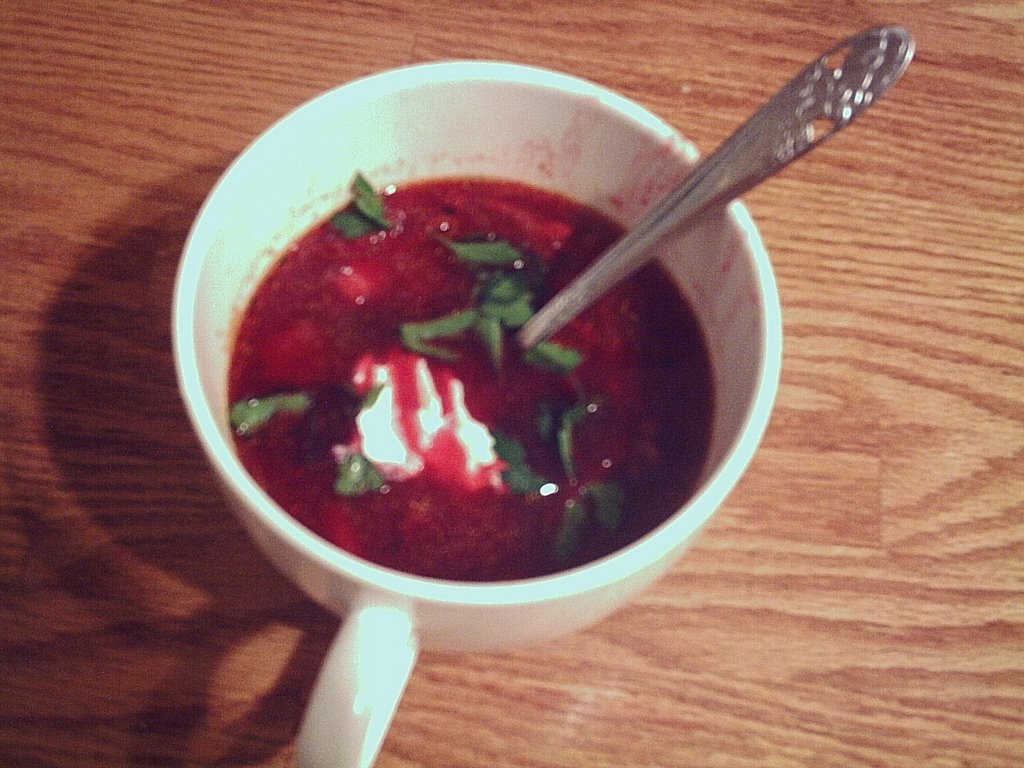
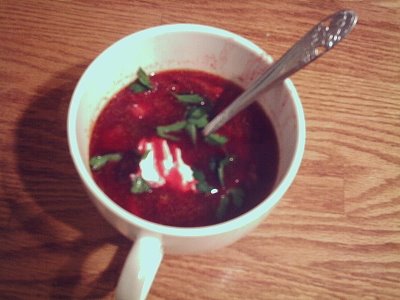
Behold, my first borsch. Not the first I’ve ever had, of course, but the first one I made all by myself. I tried to make an authentic borsch-—beefy and beety—-and I think I succeeded.

Whenever I cook something Russian, I consult my usual sources: my mom, Anya von Bremzen’s Please to the Table, Helen Rennie (who occasionally posts authentic and yummy-looking Russian recipes) and two other Russian cookbooks I own (not nearly as good as von Bremzen’s). I’d bet that every Russian family has its own way of making this beet and cabbage soup, and I cribbed ideas for my borsch from at least half a dozen recipes.

The ingredients and proportions I got from von Bremzen and Helen; the technique is mostly my mom’s. As usual, I did not measure my ingredients precisely, so this is more of an annotated field guide than a recipe. Finally, if you’ve never had borsch, please don’t let the words “beets” and “cabbage” scare you. Borsch is not a boiled vegetable soup; when made correctly, it is hearty, beefy and zesty.

For the stock, which I made a day in advance, I used a pound of beef chuck, a couple of beef marrow bones, a soup bone, and some carrots and onions. These I covered with 4-5 quarts of water, brought it to a gentle boil, and then simmered for three hours, removing the scum from the surface as necessary. Quite a few recipes suggest using a ham bone in the stock as well, a good idea. The stock served its purpose, but I next time I want something meatier and beefier. I used too much water, too—3 quarts is enough, I think. Anyway, once the stock cooled, I refrigerated it overnight.
While I was making stock, I washed and trimmed 3 medium beets. I covered them with water in a saucepan and simmered them for 50-60 minutes. Beets are done when you can pretty easily pierce them with a knife.

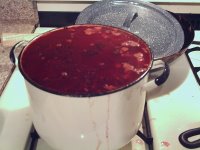
The next day I degreased the stock, threw out the bones, cut the cooked beef chuck into 1-inch cubes and added it back to the stock. I brought about 3 quarts of stock to a simmer in a big soup pot. Why three quarts? My big soup pot wasn’t nearly big enough to hold all of it (see above photo). The rest of the ingredients turned out to be proportionate to the amount of stock I did use, though.

While waiting for the stock to come a simmer, I grated the beets and put them in a saucepan with a 14-ounce can of crushed tomatoes, half a 6-ounce can of tomato paste, a big pinch of salt, sugar, and a splash of red wine vinegar. I simmered this on low heat, stirring occasionally. Did you know that beets and tomatoes are surprisingly delicious combination?

When the stock came to a gentle boil, I added a bay leaf and 3 medium peeled and cubed potatoes to the soup pot. While the potatoes were cooking—about 15-20 minutes—I finely shredded ½ pound of cabbage (about ¼ head of a medium cabbage). I also diced 2 big onions, 4 medium carrots, a green pepper, and crushed 4 cloves of garlic. ( A note on the green pepper: my mom’s and von Bremzen’s recipes call for it; others don’t. I say, use green peppers if you like them—I do—and forget them if you don’t. )

When the potatoes were almost done, I added the cabbage to the soup pot. Meanwhile, I sautéed the onions, carrots and pepper in sunflower oil until the onions were soft and golden—15 to 20 minutes or so. I stirred in the garlic at the end. When the cabbage was soft, about 20 minutes later, I added the aromatics to the soup pot, along with a tablespoon and a half of salt. All this simmered for 5 minutes, then the beet/tomato mixture went into the pot. I let the soup simmer for 10 more minutes. I also added a small handful of black peppercorns to the pot.

Then I came to the part when, in my family, everyone stands around the soup pot and tastes the borsch while my mom asks, “What’s missing? Salt, sugar, acidity?” My borsch was missing all of these, so it was time to add a little of each, stir, taste again, and repeat until satisfied. I put some more tomato paste into a little bowl, along with a splash of tomato juice left over from the canned tomatoes, a splash of vinegar (substitute lemon juice), a splash of soup liquid, a dash of sugar and salt, and a heaping teaspoon of so adjika.

Adjika is a very spicy Georgian vegetable relish that’s sold in Russian/Eastern European stores. Do borsh recipes generally call for adjika? No. Can you use it to give your borsch a little kick? Yes. My mom sometimes uses lutenitsa, a vegetable spread, also sold in Russian groceries. Should you use, say, salsa, to flavor your borsch? I say no; it’s not at all authentic. Can you use a vegetable fix-in of Eastern European origin? I say yes, if it’s tomato-and-pepper-based. Don’t worry if you have neither adjika or lutenitsa; all you really need is tomato paste, sugar, salt, and vinegar or lemon juice.

I’d estimate that I used 2 teaspoons of sugar, a tablespoon of vinegar, and a 6-ounce can of tomato paste to flavor my borsch. Taste and repeat, taste and repeat. Before serving, try adding a couple of raw, crushed garlic cloves to the pot. Borsch should strike a nice balance between sweet and sour, tomato-y and beety, salty and zesty, with a little kick that comes from the crushed garlic or adjika.

Serve borsch with chopped dill or parsley, and sour cream. Bread is essential; good rye bread is preferable. Everyone tells me that you’re supposed to stir sour cream into the borsch, but I like to leave a thick clump in the middle of my soup bowl and swipe at it with each tablespoon. This borsch is even better on the second day, keeps for a week in the fridge, and feeds a small kolhoz.

Wednesday, January 10, 2007

Cooking Notes

*When making farmer's cheese, do not ever use buttermilk containing sodium citrate. Ask Harold McGee for a scientific explanation. All I can say is that your milk won't curdle properly, the cheese will have the texture of styrofoam and you'll end up tossing the whole thing.

*How come my cooking never tastes as good when I follow recipes precisely? I'm one of those cooks who looks at recipes for ideas and techniques but rarely follows the steps. Either I don't have all the ingredients, or the recipe instructions seem off, etc. And it usually turns out fine! Here's what happens when I follow recipes to the letter:

Anya von Bremzen's avgolemono, from Please to the Table.

I think this recipe is fussier than it needs to be. Anya has you saute onions and add four spices to your usual chicken stock, eggs and lemon. The soup tastes ok, but would be just as good with the basic ingredients. All you really need is top-notch chicken stock.

Meatballs in pomegranate sauce, also from Please to the Table. These were fine. Not great, like Lindy's, but fine. A little too tart and a little dry, but...fine.

Chickea and chicken dumplings. I really had high hopes for these. The recipe is exotic but not terribly difficult. The Wednesday Chef tried it and gave a thumbs-up. But my dumplings turned out dense and bland! I regretted wasting excellent, homemade chicken stock on these. What happened? I suspect it's more my fault than the recipe's. I've never made dumplings of any kind before, and produced the dreaded leaden cannonballs on my first attempt. I wasn't inspired to take a photo.

Tuesday, January 02, 2007

New Year

New Year is the big holiday for Russians. New Year, as Vasilisa puts it, is a totally secular mix of Christmas, Halloween and New Year's. Kids dress up in costumes, presents are exchanged, a New Year's tree is decorated, Grandfather Frost (Santa) does his rounds, there’s lots of food and all-night revelry, people get drunk, etc.

Americans often assume that Russian immigrants, many of whom are Jewish, celebrate Hanukkah. This isn’t so in my experience. Hanukkah is a totally foreign holiday for Russians, most of whom weren’t aware of its existence before coming to the U.S. I remember my mom dutifully lighting a menorah, given to us by Jewish Family Services, our first year here. This ritual was unusual; her heart wasn’t in it. We put up a tree, which shocked the Jewish Family Services volunteer who was helping us adjust to life in the States. “A Christmas tree?” he said, arching his eyebrows. My mom shot back that it’s a New Year’s tree, not a Christmas tree. Next year, the menorah stayed in the box.

In my family New Year is not as big a deal as it was back in the old country. When we came to the U.S. I wanted to celebrate Christmas, like the rest of the kids at school. I wanted a Christmas tree put up in early December, not a few days before Jan. 31. I wanted to open presents on Christmas morning. I wanted stockings hung above a fireplace and Christmas carols and all the rest. My parents weren’t terribly enthusiastic about the whole thing, but they obliged me. Later, however, they had American friends who did celebrate Christmas, so we got invited to quite a few Christmas dinners over the years. Having a big dinner and exchanging presents on Christmas day stuck.

Taking up new traditions doesn’t mean you give up the old ones. We still celebrate New Year Russian-style these days: that is, we sit around on New Year’s eve and eat. The best part of a Russian New Year is the food, usually a buffet of appetizers and snacks, chased down by vodka. According to my dad, this was more fun in Soviet Russia, where a food-laden table on New Year’s made a pleasant contrast to daily food shortages. You stood in line for hours on Jan. 31 to buy a pineapple; you ran all over town to find this or that delicacy. Why get excited about stuffing your face here in America, where you can buy pineapple year-round and eat more than your fill every day?

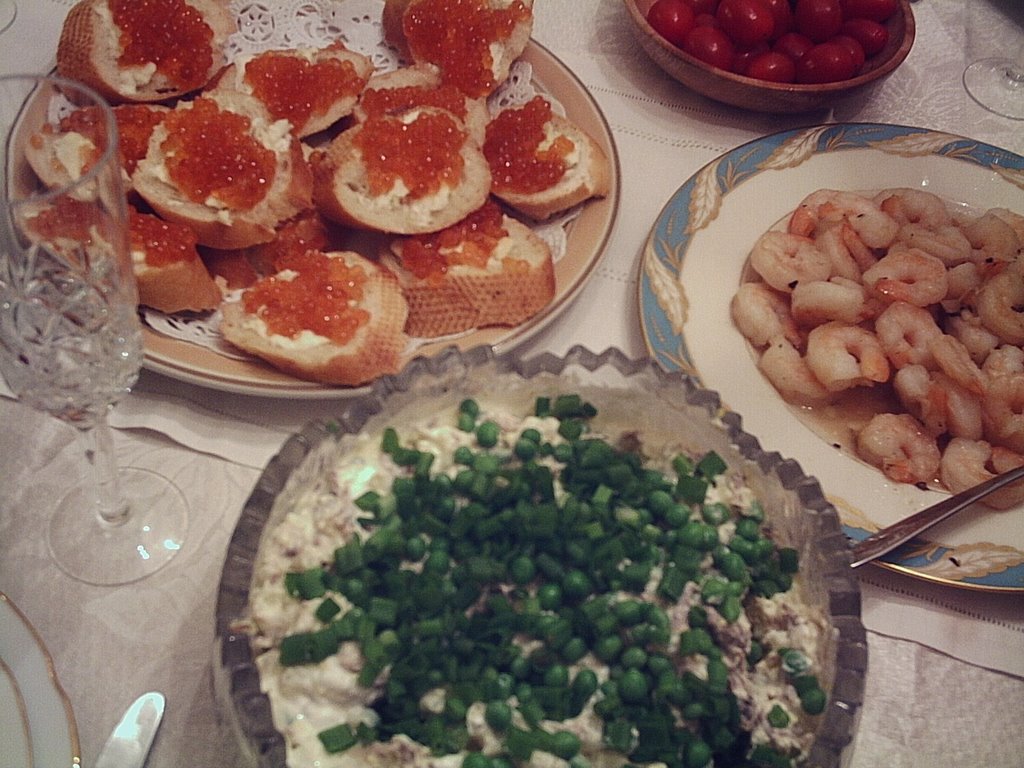
I say because it’s a pleasant tradition. I have to note, though, that our New Year's feasts have gotten smaller and smaller every year. Here’s what we had this year:

Red caviar canapes. Slice a baguette into rounds, spread a little softened butter on each slice and top with a teaspoon of caviar. Below is potato-beef salad, a classic Russian winter salad. Cook a piece of beef chuck as if making stock. Cut the cooled meat into cubes, combine with cooked, cubed potatoes, cucumbers, pickles, green peas, parsley and a mayo-based dressing. To the right is shrimp and cocktail sauce. Oops, that’s quite American.

Eggs stuffed with sautéed mushrooms and onions.

That's smoked eel beneath the pickles. I prefer smoked herring.

Napoleon, a once-a-year treat. I wrote about it here.

Tuesday, December 26, 2006

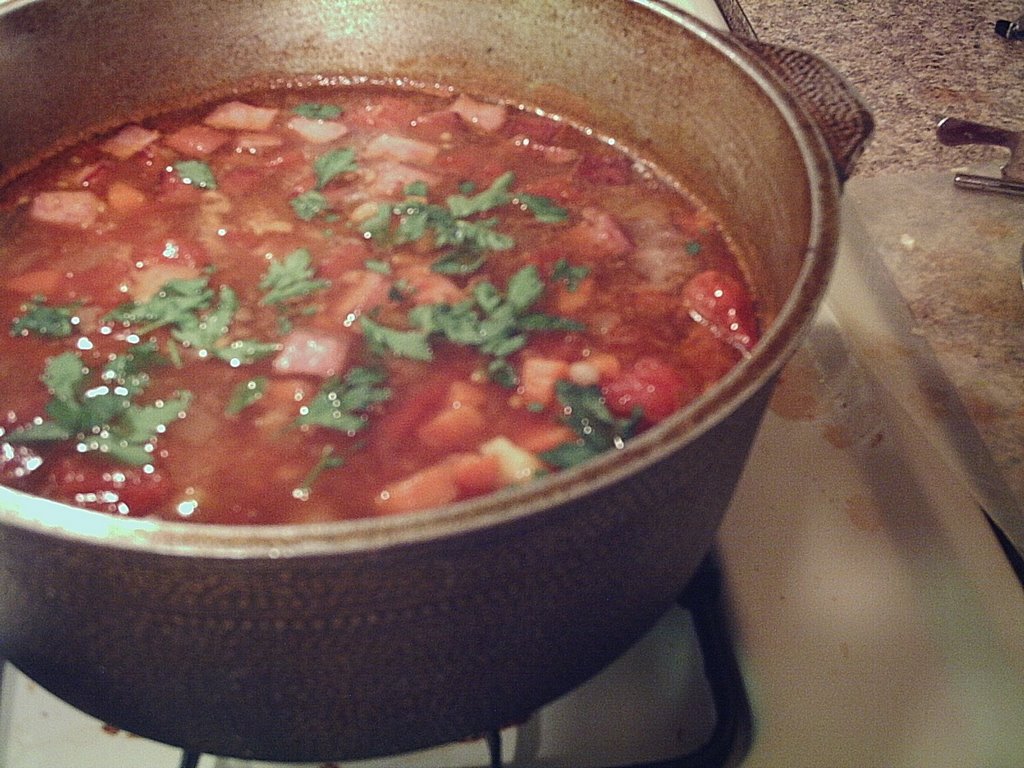
Hearty Tomato Bean Soup With Sausage

Reader, I made the most delicious soup last week. Now, I’ve been making soup quite often for the past couple of months. I once weakly complained about having to eat soup every day when I was a kid, but I really didn’t mind that at all. I love soup and would happily eat it daily for lunch and dinner, as long as I could have some nice bread and cheese on the side.

The soups I’ve been cooking lately are semi-vegetarian, pureed concoctions. These soups are new to me--creamy vegetable soups aren’t the soups I grew up with. No, soup at home was always a chunky and meaty affair. Now that I’m living on my own, soup-making more often involves chicken stock and a blender rather than marrow bones and beef chuck. But I am not giving up on the soups of my childhood. After a round of creamy tomato and butternut squash soups, I’m back to my all-time favorite: tomato bean soup, full of rich, satisfying, stick-to-your-ribs goodness. Don’t bother serving a crisp, green salad on the side. Offer some hearty, buttered bread instead, and watch your guests slurp this stuff until they are pink-faced and sated.

I wrote up a recipe last year, but I always toy around with the basic formula. This time I added some smoked kielbasa, with excellent results.

Method: Soak a cup of navy beans in 3-4 cups of water overnight. Place the beans in a pot with 4-5 cups of water and bring to a boil, then lower the heat to a simmer. Cook until the beans are soft—60 to 90 minutes. Reserve a cup or two of the water.

Slice about ½ pound of sausage or kielbasa into rounds, heat some olive oil in a Dutch oven and saute the sausage until it is golden on both sides. I used Polish kielbasa from the Russian store, but you can use whatever sausage you like. Take the sausage out of the pot and set aside.

When the beans are close to done, heat up a little more olive oil in the Dutch oven and saute a large onion and two medium carrots until the onion is soft and golden. Add three minced garlic cloves and saute for a couple more minutes. Add the beans, two medium peeled, diced potatoes, a bay leaf and five cups of chicken stock.

Bring the whole thing to a boil, and then lower the heat to a simmer. When the potatoes are nearly tender, add a 14-oz can of good, whole tomatoes. Break them up into chunks with a spoon. Stir in a little brown sugar (this depends on acidity of the tomatoes and personal taste—I like about a tablespoon of sugar); a tablespoon of sweet paprika; a pinch of hot red pepper flakes or a dried, hot chili pepper; and salt to taste. Simmer for 30 minutes. Just before serving, stir in the sausage. Sprinkle with fresh parsley. If the soup is too thick the next day, add more stock or some bean cooking water.

Sunday, December 17, 2006

On Kasha

 Like many Russian kids, I grew up eating kasha. In the U.S., the word kasha refers to buckwheat, while in Russia, kasha means porridge, served hot, usually for breakfast. There's semolina kasha (cream of wheat), oatmeal kasha, millet kasha, rice kasha, and--why not?--buckwheat kasha, among others. In my family kasha was always made with milk, and eaten with a pat of butter and a handful of raisins.

I bet that Russian kids hate kasha as much as American children hate broccoli or brussels sprouts. Kasha is one of those foods that parents force on kids. I grew up hearing that you must eat a lot of kasha to be healthy and strong. Even now, when I have trouble opening a jar or something, my mom shakes her head and says that I haven't eaten enough kasha. Watery, bland kasha served in Soviet cafeterias also has something to do with the revulsion some people feel toward porridge.

Me, I've always liked kasha, especially oatmeal, cream of wheat and rice. Oatmeal and cream of wheat are self-explanatory; rice kasha is perhaps the Russian equivalent of rice pudding. Milk and rice are cooked together until the rice absorbs most of the milk; this kasha is eaten with a little butter and sugar. Undoubtedly I like kasha because my mom and grandmother made it well, with milk. Occasionally my mom will ask me, who is nearly American, why Americans do this or that. One of her more frequent questions is why do Americans make their hot cereal with water instead of milk? I don't know, Americans, why do you? Hot cereal made with milk is creamy comfort food; made with water, it's dour diet food. I confess that American rice pudding eaten cold is, too, a mystery. Why eat cold milky rice when it tastes so much better hot?

I don't eat kasha very often anymore--I hardly need to grow big and strong at this point. But every once in a while I get a craving for it. Here's a recipe for oatmeal, made mama's way.

Gerkylesovaia Kasha (Oatmeal)

Bring a cup of milk to a slow boil using medium-low heat. Add a pinch of salt and sugar, then slowly add 1/2 cup of oatmeal (rolled oats; not instant). Reduce the heat to low, and let the oatmeal simmer 10-15 minutes, stirring every couple of minutes. If the oatmeal is too thick, add a splash of milk. Eat with a little butter and a handful of dried fruit of your choice--I like cranberries and cherries.

Saturday, December 16, 2006

Grated Pie

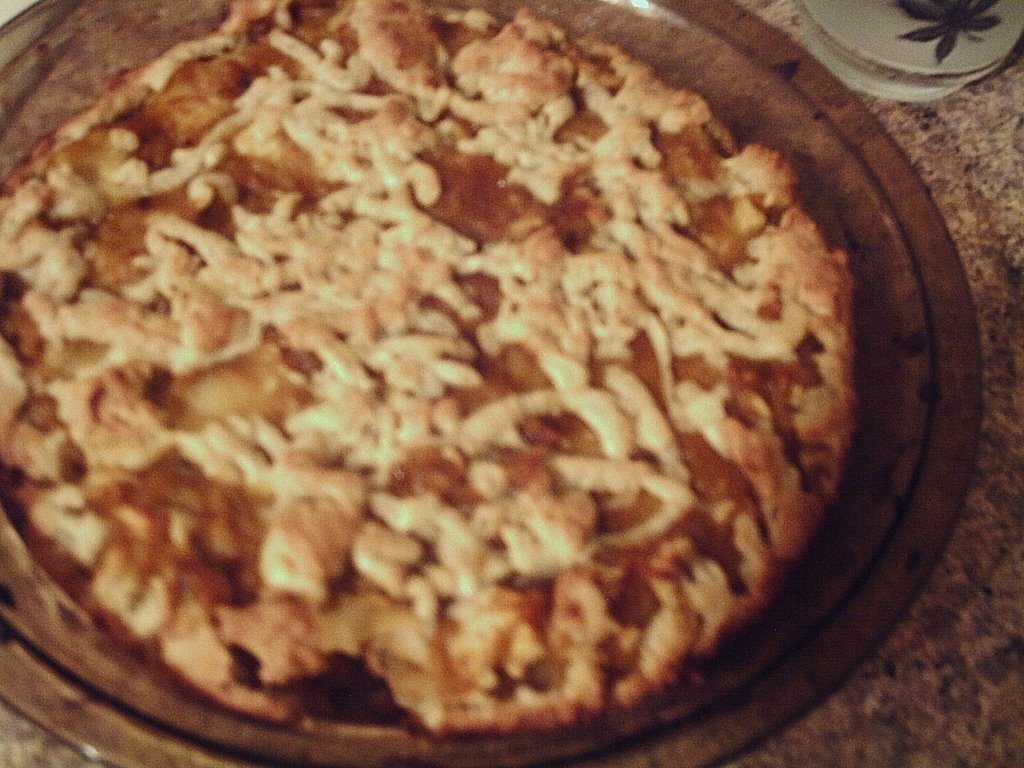
Grated pie, probably an invention of my late grandmother, is pie made of pastry dough that is frozen and then grated, instead of defrosted and rolled out. I hesitate to compare this dough to pâte brisée, since the recipe is completely unorthodox, but pastry crust is what it tastes like when baked. This is an admittedly odd recipe and technique, but it’s a longtime family favorite because it's easy and convenient. You can make the crust and freeze it, and when you have a hankering for some pie all you need is a pie pan, filling and a grater. I have yet to make this dough myself, but this recipe has always worked for my mom. I used one of her ready-made batches to bake a very good apple-pumpkin pie a couple of weeks ago.

For the crust: Beat together 3 eggs and 1 cup of sugar. Melt 2 sticks of butter; cool, add to eggs and sugar. Add 2 tablespoons of sour cream; mix well. Sift 2 cups of flour and 1/2 tsp. baking soda. Add the flour to the wet ingredients gradually, and knead until you form dough. Add more flour if the dough is too wet--about 1/2 cup should do it. Divide the dough into two rounds, wrap, and freeze.

For the filling: I sautéed four sliced, peeled and cored apples in some butter. When the apples were soft, I added a splash of Calvados, some sugar--1/3 cup, maybe?--a little nutmeg, ground cloves, cinnamon and ground ginger, and about a cup of canned pumpkin (not pumpkin pie filling).

For the pie: You’ll need ½ crust recipe (one frozen round of dough). Butter a 9-inch pie pan. Grate the frozen dough until it covers the bottom of pan. Use your fingers to press on the dough so that it covers the entire pan and its sides. I used about ¾ of the dough round for this. Add the filling, spreading it evenly over the dough. Grate the remaining dough over the top. Use your fingers or a knife to fold the dough on the sides onto the filling. Bake at 350 for 40-50 minutes, until the crust on top is nicely golden. Let cool.

Tuesday, December 05, 2006

Middle Eastern Lentil Soup

I don't usually get excited about vegetarian lunch buffets, but I love the buffet at local Middle Eastern restaurant Casablanca. I've been to Casablanca for dinner, too, and it was fine, but the menu wasn't nearly as interesting as the lunch selections. Such as, for example, chunks of buttery braised cabbage with cumin and lemon juice. And veggie stew made with eggplant, peppers, tomatoes and potatoes. and spicy yellow lentil soup.

Whenever I have lunch at Casablanca I vow to recreate all these dishes at home. (Much thanks to anyone who can point me to a good Middle Eastern cookbook or braised cabbage recipe.) Last week I made what I think was a surprisingly good imitation of Casablanca's lentil soup. I did use split peas and chicken stock instead of yellow lentils and vegetarian-friendly water/veggie stock, but the soup hardly suffered for it.

Soak 1 cup of split peas overnight. In a stock or soup pot, bring 4 cups of chicken stock to a simmer, then add the peas and cook until they're soft--about 30 minutes. Don't worry if the peas get mushy; you'll be pureeing the soup later on.

When the peas are close to being done, dice a large onion and a couple of carrots and sauté in olive oil until the onions are soft and golden--about 10 to 15 minutes. Add a heaping teaspoon of coriander and a heaping teaspoon of cumin to the vegetables, cook for another minute. Add the caramelized vegetables to the soup pot, along with a bay leaf, and simmer for 15 minutes. Add salt and cayenne to taste--I used 1/8-1/4 teaspoon of cayenne, which was plenty for me. Take the soup off the heat, remove the bay leaf and puree the soup in a blender or food processor in batches. Add more stock or a little water if it's too thick. Serve with wedges of lemon and squeeze lemon juice into the soup before eating. A dollop of plain yogurt wouldn’t be bad either.

Sunday, November 26, 2006

Thanksgiving Scenes

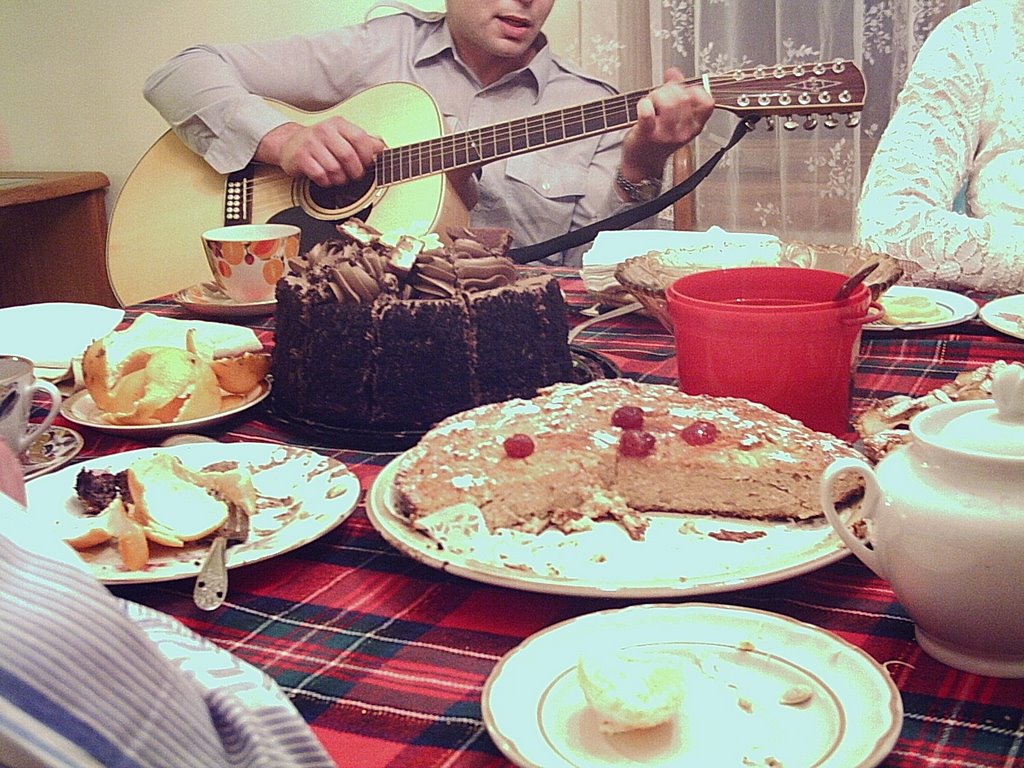
I did very little cooking this Thanksgiving but I dutifully chronicled dinner at my parents'. Those not in on my blogging were amused that I took pictures of food instead of people.

Making seledka pod shuboi--herring in a fur coat. This may be the Russian version of seven layer salad. Diced smoked herring is on the bottom, topped with diced cooked potatoes, carrots, and beets, hardboiled eggs, a tart apple, and mayo/sour cream dressing.
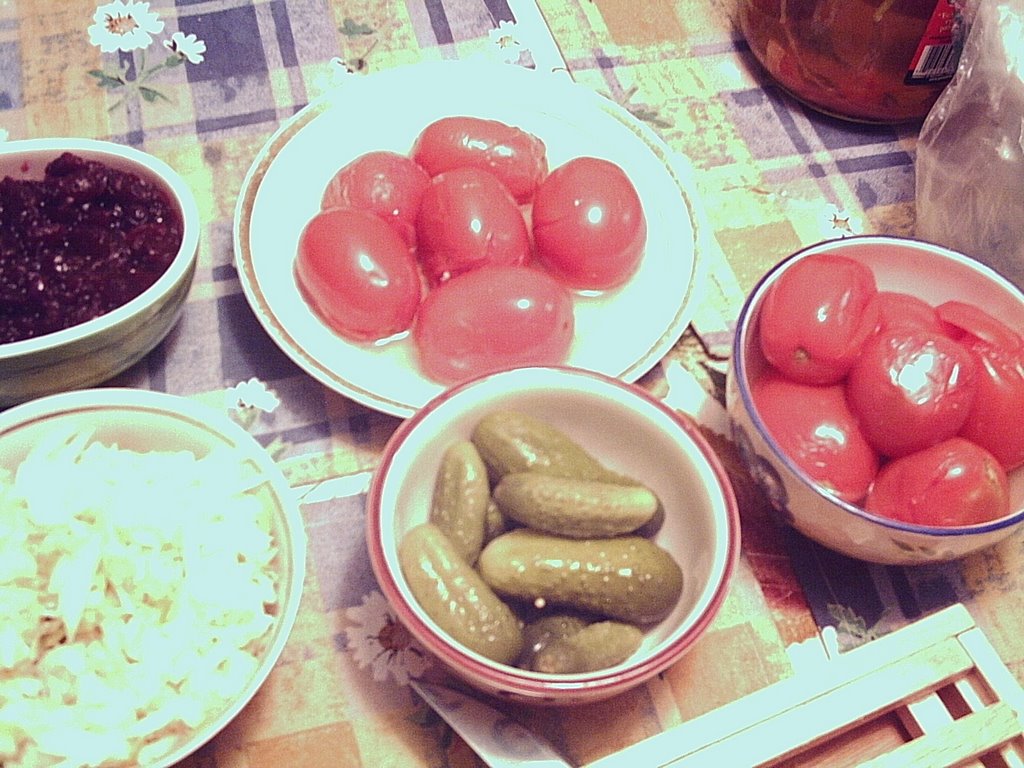
The sides: marinated tomatoes, homemade sauerkraut (my parents' was better than mine), cranberry sauce, and pickles. The marinated tomatoes were awesome; I always buy them at the Russian store. I can't remember the name of the brand I like best--it's the one with a red-nosed, drunken-looking babushka on the label. I could eat these sweet and spicy tomatoes like candy.
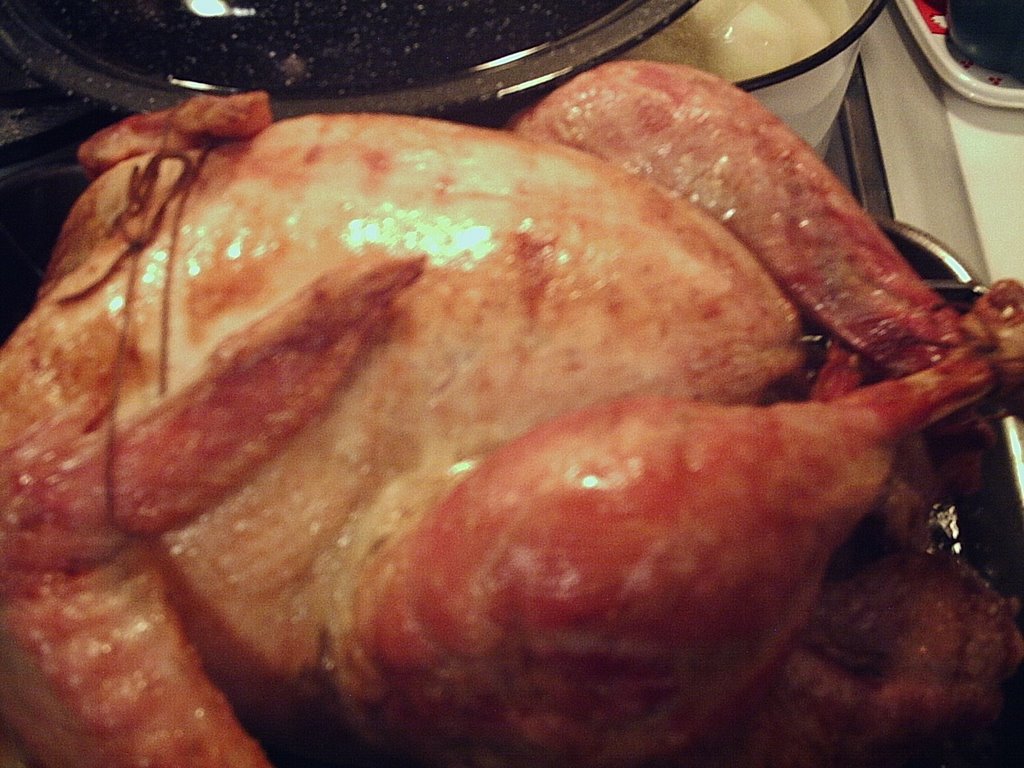
The beast:

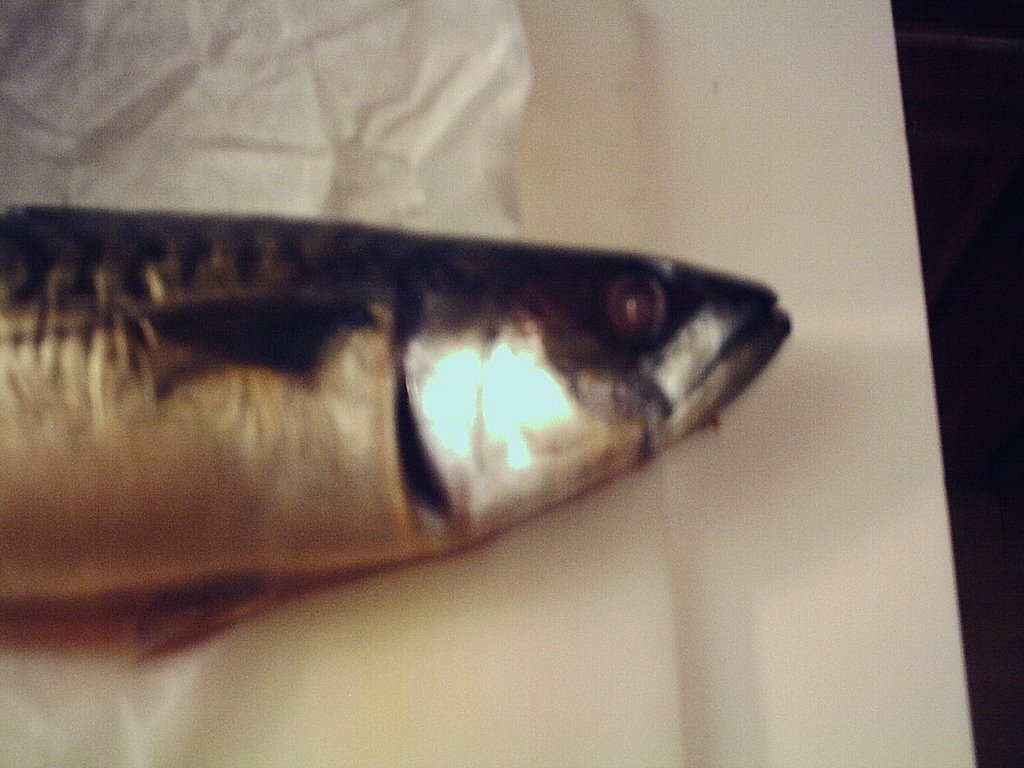
Does this say Thanksgiving to you? That's smoked mackarel, part of the appetizer spread. Fatty and yummy.
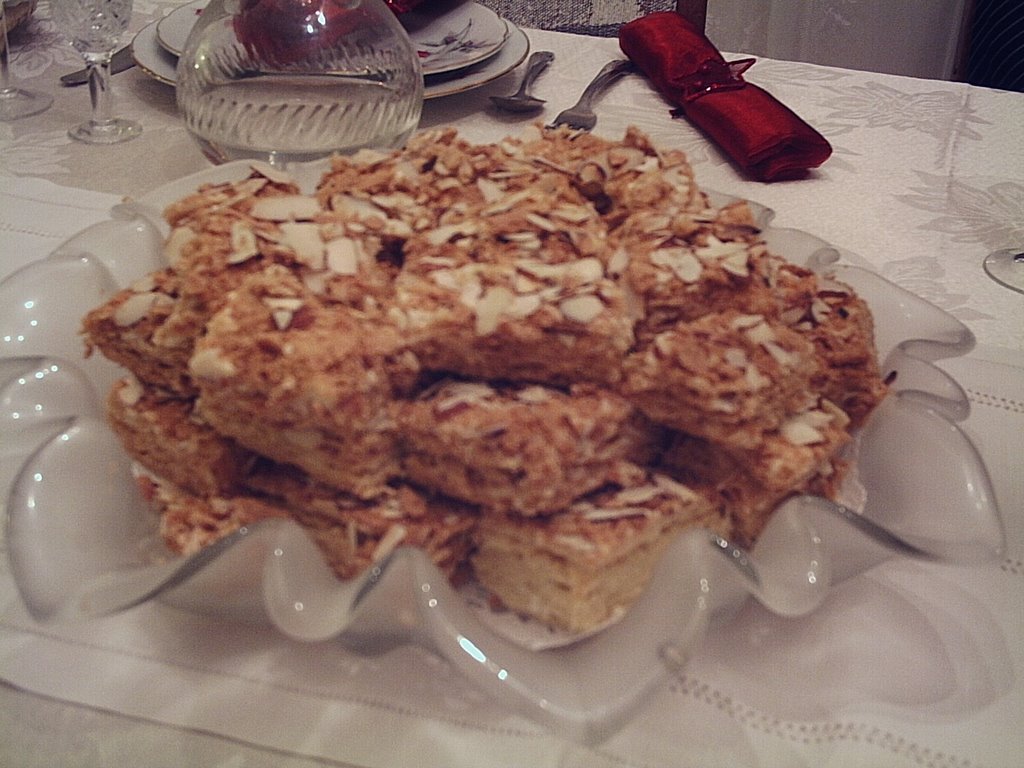
Dessert: An apple charlotte and curd cheese cake with grated apples (pictured below), recipe courtesy of the blog Nami-Nami. The curd cheese cake was excellent: light, fluffy, not too sweet; a great use of farmer's cheese.
After dinner entertainment: Russian pop songs. The only one I recognized was Dark Eyes.

Wednesday, November 15, 2006

Sauerkraut in Action

Above is a photo of sauerkraut-making in action. Helen of Beyond Salmon tipped me off to this recipe, helpfully reviewed on her blog. My sauerkraut is currently on day three of fermenting, and I’m excited to think that it could be done as early as Friday. Never having pickled anything besides some super-easy pickles, I approached this first sauerkraut-making venture with trepidation. I called my parents for guidance. My sauerkraut-making worried them. "Did you chop the cabbage before putting it in the bucket?" was my dad's first question. "Did you remember to salt it?" my mom wanted to know. They insisted that I’m making a big mistake in not following their recipe. What’s my parents' recipe? It’s sort of like Helen put it:

“Take lots of cabbage, sprinkle with some salt, put in a bucket, and wait for
it to ferment.”

Except after tossing the cabbage with salt, my parents pour in a little warm water mixed with sugar into the bucket to start the fermentation. The recipe I’m using calls for cold water with salt. Whose recipe will yield crispier, crunchier, tangier kraut? Time will tell.

Sunday, November 12, 2006

Peanut Butter Bread

I just caught on to National Blog Posting Month, when bloggers are encouraged to post every single day during November. I'm now all excited about blogging more often, although I will probably come to my senses tomorrow. In the meantime, I'll play around with this mini-post approach:

I say peanut butter bread is a great idea. I like peanut butter but I hate how it's used in baking--usually as part of sugary sweet slop involving chocolate. What a revelation this bread was!

I made two small changes in the recipe--I reduced the sugar to 1/4 cup and baked the bread in a 9" by 11" cake pan instead of a loaf pan. The final result is slightly sweet, fluffy, and nutty. This bread was a great addition to my weekend breakfast of yogurt and tea. It was also good smeared with plain cream cheese or drizzled with honey.

The recipe comes from Cooking With Yiddishe Mama. New food blogger Alla Staroseletskaya posts Eastern European and American recipes in Russian and English. I can't wait to try this farmer's cheese apple cake.
Related Posts with Thumbnails